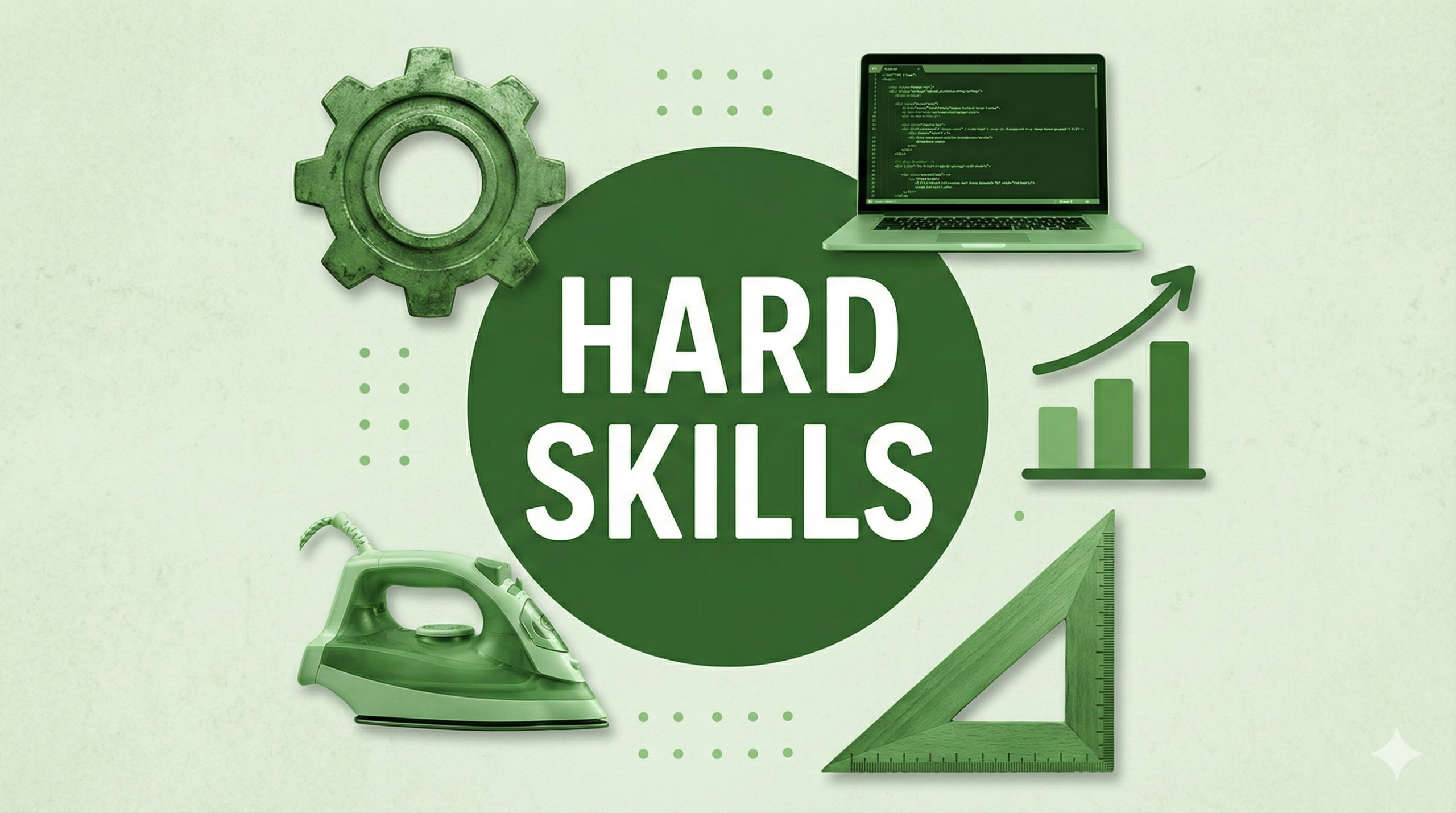
Practical Guide to Developing Your Hard Skills in 2026
What are Hard Skills?
Hard Skills, or technical skills, are a fundamental pillar in building a strong professional career. They are specific, measurable abilities—such as computer programming, accounting, project management, or engineering—that enable employees to perform particular tasks with precision and efficiency. Developing these skills is crucial to remain relevant and competitive in a constantly evolving professional environment. Companies can support this development by offering specialized training, encouraging certification, and providing continuous learning opportunities. In this way, employees can not only improve their current performance but also prepare to advance in their careers and face new professional challenges with confidence and competence. Investing in these technical skills also strengthens employees’ capacity to innovate and contribute meaningfully to the company’s growth and adaptability in the face of market changes and new technologies.
Table of Contents
Definition of Hard Skills
Hard skills represent the technical abilities and specific knowledge required for a given profession. Historically central to candidate selection, they remain essential but are no longer the only deciding factors to convince recruiters today. Unlike soft skills, which relate more to personal and behavioral traits, hard skills can be learned through training or may be innate.
For example, a manager specialized in Big Data must master advanced techniques for analyzing digital data to make informed decisions. Similarly, for a role in international trade, language proficiency in one or more foreign languages is essential for communicating with international clients and partners.
However, combining hard skills with soft skills has become crucial for modern professionals. Companies increasingly value employees’ ability to collaborate effectively, communicate clearly, solve problems, and adapt to rapid market changes. Thus, while hard skills remain a solid foundation for professional performance, their complementarity with soft skills is essential for success in a dynamic and evolving work environment.

Why are hard skills important?
Over the past five years, the importance of hard skills to recruiters has evolved, influenced by rapid technological changes and the growing automation of tasks. The digitization of businesses and advances in data and artificial intelligence have reshaped labor market requirements, making some skills obsolete while creating demand for new ones. This dynamic leads to accelerated obsolescence of technical skills, especially in IT fields where technologies change quickly.
However, this does not mean recruiters have abandoned hard skills. On the contrary, in a context of fast technological progress, specialized skills become rare and highly sought after. For example, professionals in cloud computing and cybersecurity are in strong demand because of their ability to operate in complex, highly technical environments.
To meet these challenges, companies must adopt a proactive approach to continuous training and skills development, integrating both traditional hard skills and emerging competencies. This not only ensures employees’ competitiveness in the job market but also their ability to adapt to innovations and changing demands in their industry. Thus, despite their evolution, hard skills remain an essential pillar for professional success, complemented by adaptability to new technologies and market needs.
How to Develop Hard Skills
Discovering and strengthening your technical skills—essential for your career progression—requires a structured and proactive approach. Our guide to developing Hard Skills offers proven strategies to achieve this goal successfully. First, invest in specialized training and relevant certifications. Second, engage in practical projects and collaborative initiatives. This will allow you to apply acquired knowledge and gain concrete experience in your field. Third, take advantage of mentoring and coaching to benefit from expert advice and feedback that will enrich your professional journey. Finally, stay informed about technological developments and market trends to anticipate future technical skill needs. By following these recommendations, you will be better equipped to advance your Hard Skills and meet the growing demands of the modern labor market.
Training and Certifications in Hard Skills
Investing in training and obtaining certifications is a fundamental pillar for developing Hard Skills. These programs are designed to give professionals the unique opportunity to acquire and refine specific technical abilities in response to the evolving demands of the modern labor market. Whether in areas such as computer programming, data analysis, cybersecurity, or project management and leadership, these trainings allow you to deepen your expertise and stay at the forefront of technological advances.
The resulting certifications play a crucial role in attesting to the mastery of acquired skills, which strengthens professional credibility and increases competitiveness in the job market. They serve as formal validation of technical knowledge and skills, reassuring potential employers about candidates’ capacity to meet the specific challenges of their roles.
In short, continuous training and certification are not only personal development investments but also strategic moves to maintain professional relevance and long-term performance. They allow individuals to stay aligned with rapid technological advances and to respond effectively to the changing demands of today’s world of work.
Practice and Experience
Practice and hands-on experience are essential for developing Hard Skills. By tackling real-world challenges daily, individuals significantly strengthen their technical abilities. For example, a web developer facing complex projects learns to solve specific programming problems and optimize application performance. Likewise, a data analyst gains expertise by working with real datasets, using advanced analytical tools, and interpreting results to make informed decisions.
Regular practice not only improves technical mastery but also builds professional confidence. Individuals become more effective at performing their tasks, leading to better overall performance within their organization. Moreover, this practical experience enables them to anticipate and resolve problems encountered in the field—an essential quality for remaining competitive in a constantly changing professional environment.
In summary, combining theoretical training, regular practice, and concrete experience is an effective approach to developing and maintaining robust Hard Skills. This enables professionals to advance their careers, innovate in their fields, and respond effectively to contemporary professional challenges.
Integrating Hard Skills and Soft Skills
Harmoniously integrating Hard Skills and Soft Skills is crucial for comprehensive and effective professional development. Hard Skills provide the technical and specialized abilities needed to perform specific tasks in a given field, while Soft Skills—such as communication, leadership, and time management—facilitate social interactions and team management. This combination allows individuals not only to excel in technical execution but also to navigate a collaborative and dynamic work environment effectively. It promotes better team integration, more efficient project management, and a more meaningful contribution to the organization’s overall success. Thus, balanced mastery of Hard Skills and Soft Skills is a valuable asset for any professional seeking to advance their career and achieve their goals successfully.
Hard skills and soft skills: complementary abilities
Although the rapid obsolescence of hard skills may seem discouraging, their importance remains essential for operational success. Specific technical skills are indispensable for performing complex and specialized tasks across various professional domains. Soft skills—such as effective communication, time management, and teamwork—are also valuable but often harder to assess and find in candidates. They should complement and support hard skills, not replace them.
A harmonious balance between these two types of skills is crucial to ensure sustainable professional success. Soft skills enhance the effectiveness of hard skills by promoting smooth collaboration, efficient project management, and clear communication within teams. Continuous training plays a key role in maintaining and developing both skill sets among employees, enabling them to stay current with technological advances and to refine their interpersonal abilities. Therefore, investing in the development of both types of skills guarantees not only individual competitiveness in the job market but also overall organizational performance and innovation.
Strategies for Integrating Hard Skills
The development of hard skills primarily aims to make acquired competencies directly applicable in learners’ daily professional contexts. This means that trainings are designed to provide practical knowledge and skills that can be implemented immediately, thereby improving effectiveness and job performance. By focusing on relevance and applicability, training programs aim to ensure a smooth transition from theoretical learning to practical application.
For example, for a software developer, developing programming skills in specific languages like Python or JavaScript is essential for solving complex coding problems. Similarly, for a mechanical engineer, mastering modeling and simulation software such as AutoCAD or SolidWorks is crucial for designing and testing prototypes. These technical skills are directly transferable and enable professionals to meet the challenges of their field effectively.
By integrating these learnings into real projects or simulations, learners can consolidate their understanding and develop expertise in a practical way. Thus, by investing in the development of hard skills oriented toward practical applications, organizations can ensure their employees are well-equipped to face evolving job requirements and contribute meaningfully to the company’s success.