10 Essential Reasons to Pursue a Postgraduate Education Diploma 2026
The Heart of the Modern Educator: A Reflection on Your Journey
Imagine a classroom where the walls are no longer the boundaries of knowledge, but a gateway to a global community. Picture a space where you aren’t just a distributor of static facts, but a curator of curiosity and a builder of character. As you look toward the horizon of 2026, the world of education is undergoing a seismic, positive shift. It is no longer just about passing on a rigid curriculum; it is about navigating a digital-first, empathy-driven world where students need mentors as much as they need instructors.
Choosing to pursue a postgraduate education diploma 2026 is more than just an academic checkbox. It is a profound commitment to becoming the advocate you once wished you had in your own youth. Whether you are currently standing at a career crossroads—perhaps moving from a corporate desk to a classroom—or you are a seasoned teaching assistant ready to take the lead, the 2026 academic year represents a unique turning point. This is your chance to step into a new era of teaching with a qualification that speaks the language of the future.
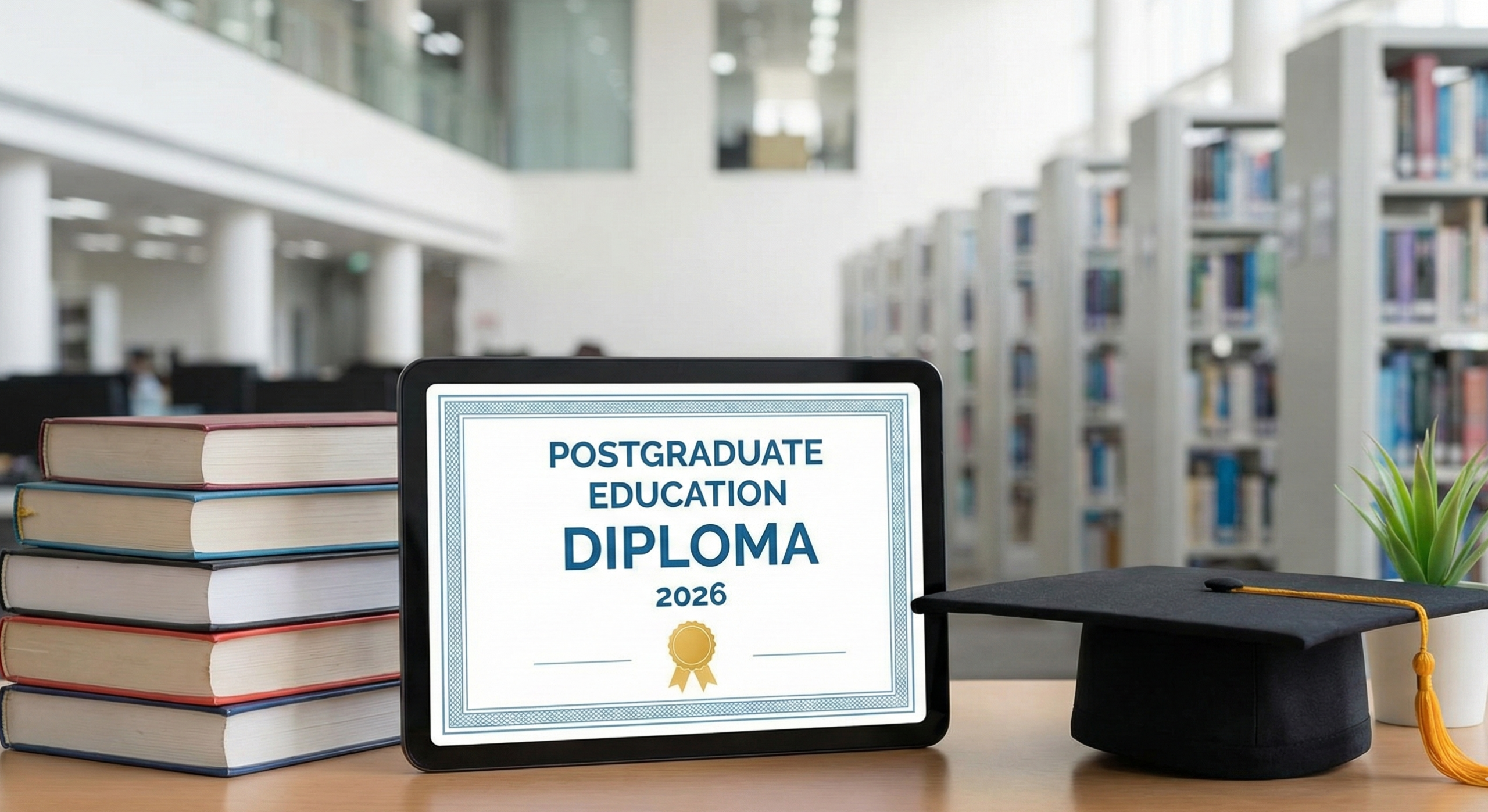
Table of Contents
What Exactly is the Postgraduate Education Diploma 2026?
If you are researching teacher training, you have likely come across a dizzying array of acronyms: PGCE, PGDE, QTS, and more. Understanding the nuances of a postgraduate education diploma 2026 is the first step in mapping out your career. While many people use the terms interchangeably, there are distinct differences that could impact your long-term salary and your ability to transition into leadership roles.
Diploma vs. Certificate: Decoding the Academic Credits
While the Postgraduate Certificate in Education (PGCE) is widely known, the Postgraduate Diploma in Education (PGDE) is often seen as its “big brother” in terms of academic depth. In the context of the European Qualifications Framework, these distinctions are vital.
- Academic Level: Both are Level 7 qualifications, meaning they are equivalent to Master’s level study.
- Credit Weighting: A standard PGCE typically awards 60 credits. In contrast, a postgraduate education diploma 2026 usually grants you 120 credits.
- The Master’s Path: Because a full Master’s degree requires 180 credits, the PGDE puts you significantly closer to that goal. You only need to complete a final dissertation or a small research project to “top up” to a full M.Ed. (Master of Education), often while you are already working as a teacher.
Global Recognition and QTS
Most high-quality diploma programs in 2026 are designed to grant you Qualified Teacher Status (QTS) alongside your academic award. This dual-pronged approach ensures you are legally qualified to lead a classroom while also holding a high-level academic credential that is respected by international schools from Dubai to Singapore. For those looking to work in the UK specifically, the Department for Education provides a comprehensive list of accredited providers.
Why 2026 is the Pivotal Year for a Postgraduate Education Diploma 2026
The year 2026 isn’t just another date on the calendar; it is the year when several long-term educational trends are expected to reach a boiling point. By the time you graduate with your postgraduate education diploma 2026, the landscape of the classroom will look radically different than it did even five years ago. This evolution creates a massive opportunity for new teachers who are trained in the latest methodologies.
The AI Integration Revolution
We have moved past the initial panic of “AI will make students stop thinking.” By 2026, Artificial Intelligence is being utilized as a “co-pilot” in the classroom. Your diploma training will likely focus on hyper-personalization, using AI tools to analyze student data in real-time to create bespoke learning paths. Furthermore, you will learn to leverage technology to handle grading and lesson planning, allowing you to spend more time on one-on-one mentorship.
Education for Sustainable Development (ESD)
Global climate goals for 2030 are fast approaching. In 2026, “sustainability” isn’t just a topic for Geography class; it is being woven into the fabric of every subject. Schools are looking for educators who can lead “green initiatives” and help students grapple with global challenges through critical thinking. If you want to see how these standards are being set, the UNESCO Education for Sustainable Development portal is an excellent resource for aspiring teachers.
The Shift to Hybrid and Immersive Learning
Virtual Reality (VR) and Augmented Reality (AR) are moving from expensive novelties to standard pedagogical tools. Your postgraduate education diploma 2026 will prepare you to manage these immersive environments, ensuring that technology serves the learning objective rather than distracting from it.
Key Modules: What You’ll Study in a Postgraduate Education Diploma 2026
The curriculum for a postgraduate education diploma 2026 is designed to be rigorous, reflective, and deeply practical. Most programs are broken down into three or four core blocks that bridge the gap between academic theory and the daily realities of the classroom.
1. Foundations of Learning and Pedagogy
In this module, you will dive deep into the “why” of teaching. This includes cognitive science, where you learn how the brain retains information and how to manage “cognitive load.” You will also study the sociology of education, analyzing how social factors like poverty, culture, and language impact a student’s ability to succeed in the modern era.
2. Subject Specialism and Curriculum Design
Whether you are training for Primary or Secondary education, you will learn how to break down complex concepts in your specific field. In 2026, there is a heavy emphasis on “interdisciplinary” teaching—showing students how Mathematics relates to Art, or how History informs modern Data Science. Mastery of your subject is essential, but being able to connect it to other domains is what makes a teacher truly stand out.
3. Inclusive Education and SEND (Special Educational Needs and Disabilities)
Modern classrooms are beautifully diverse. Your postgraduate education diploma 2026 training will provide you with techniques for differentiated instruction, allowing you to teach a classroom of 30 students who all have different learning speeds. You will also focus on neurodiversity support, gaining strategies for supporting students with ADHD, Autism, and Dyslexia.
4. Professional Ethics and Digital Citizenship
In an era of social media and deepfakes, the role of a teacher as a moral compass has never been more vital. You will explore safeguarding in the digital age, learning how to protect students from online harms while maintaining the professional boundaries of being a public figure in your community.
The Financial Reality: Career Prospects and Salary Expectations
One of the biggest questions you likely have is: Is the investment worth it? The short answer is a resounding yes. The demand for highly qualified teachers holding a postgraduate education diploma 2026 is at an all-time high, and governments are increasingly recognizing that competitive pay is necessary to attract talent.
Entering the Workforce: The 2026 Salary Scale
Upon completion, you aren’t just a “graduate”—you are a professional. In the UK, for instance, the starting salary for a teacher with QTS in the 2025/2026 academic year has seen significant upward adjustments. You can expect a baseline of approximately £32,916 in England (outside London). If you choose to teach in Inner London, your starting salary could be as high as £40,317. Many teachers move up the pay scale annually, often reaching over £45,000 within their first five to six years of service.
Beyond the Classroom: Diverse Career Paths
While many choose to stay in the classroom, a postgraduate education diploma 2026 opens doors to educational leadership roles like Head of Department, Assistant Head, or Headteacher, where salaries can exceed £100,000. You might also find yourself in learning design, creating educational content for EdTech companies, or in international teaching, which often offers tax-free salaries and housing allowances.
Admission Requirements for the Postgraduate Education Diploma 2026
Securing a spot for the 2026 intake requires early planning. Most universities begin accepting applications through portals like UCAS in the autumn of 2025.
The Basic Prerequisites
To be eligible for a postgraduate education diploma 2026, you generally need:
- A Bachelor’s Degree: Usually a 2:2 or higher. For secondary teaching, your degree should ideally be related to the subject you wish to teach.
- English and Math Competency: A standard competency level (such as GCSE Grade C/4 or equivalent) is required to ensure you can support the literacy and numeracy of your students.
- Relevant Experience: While not always mandatory, having spent time in a classroom setting—whether volunteering or working as a teaching assistant—significantly strengthens your application.
Crafting a Winning 2026 Personal Statement
For the 2026 cycle, universities are looking for more than just a love for children. They want to see reflection. What did you learn from your observations in a school? They want to see awareness of current issues, such as the digital divide or mental health support. Above all, they want to see resilience—the ability to handle the high-pressure environment of a modern school.
The Importance of Accreditation and Reputation
When selecting your postgraduate education diploma 2026 provider, you must look beyond the glossy brochure. Accreditation is the lifeblood of your future career. Ensure that your chosen institution is recognized by the relevant national body. In the United States, for example, the Council for the Accreditation of Educator Preparation (CAEP) is the gold standard.
University-Led vs. School-Centered Training
In 2026, you generally have two paths:
- University-Led: You spend more time on campus, engaging with deep academic research and theory before spending blocks of time on placement in schools.
- School-Centered (SCITT): You are based in a school from day one, “learning on the job” with the support of a university for the academic portion of your diploma. Both paths are valid, but your choice depends on whether you prefer academic immersion or practical, hands-on experience from the start.
International Opportunities with a Postgraduate Education Diploma 2026
One of the most exciting aspects of this qualification is its portability. The global demand for high-quality education is exploding, particularly in the Middle East and East Asia. A postgraduate education diploma 2026 is often seen as the “gold standard” for international recruitment.
The “Golden Ticket” to Global Travel
Many teachers use their first two years post-qualification to gain experience in their home country before venturing abroad. International schools often look for teachers who have a firm grasp of a specific curriculum (like the British National Curriculum or the International Baccalaureate). With your diploma, you could find yourself teaching in a school in Switzerland, a coastal city in Spain, or a high-tech campus in South Korea.
Top 10 Benefits of Enrolling in a Postgraduate Education Diploma 2026
- High Employability: Teachers remain one of the most recession-proof professions in the world.
- Accelerated Career Growth: The 120-credit structure allows for a faster transition to a Master’s degree.
- Financial Support: Many subjects offer tax-free bursaries that can cover your tuition and living costs.
- Global Portability: Work in almost any country with an internationally recognized qualification.
- Digital Mastery: Gain hands-on experience with the AI tools that will define the next decade of work.
- Personal Fulfillment: Make a tangible difference in the lives of young people every single day.
- Leadership Opportunities: The PGDE is a respected foundation for moving into school management.
- Professional Networking: Join a community of scholars and practitioners who are shaping the future.
- Resilience Building: Develop the emotional intelligence and problem-solving skills valued in any industry.
- Pension and Benefits: Teaching often comes with some of the most robust pension schemes available in the public sector.
Frequently Asked Questions (FAQ)
How long does it take to complete a postgraduate education diploma 2026?
Typically, it takes one year for full-time students (usually 36-40 weeks) or two years for part-time study. Some “fast-track” programs exist for those with significant prior experience, but one year is the standard for a postgraduate education diploma 2026.
Can I teach internationally with a postgraduate education diploma 2026?
Yes, most PGDE qualifications are internationally recognized, especially when paired with QTS. This allows you to work in English-speaking schools and international institutions worldwide.
What is the difference between a PGCE and a postgraduate education diploma 2026?
While both lead to teaching status, a diploma (PGDE) often involves more credits (120 vs 60) and can provide a more direct path to a full Master’s degree. For many, the PGDE is the preferred choice for long-term academic progression.
Are there scholarships available for the 2026 intake?
Yes, many governments offer bursaries or “Teacher Training Scholarships” worth up to £31,000 for high-demand subjects like Physics, Maths, and Computing. You can check the latest availability on the Get Into Teaching website.
Is AI a major part of the postgraduate education diploma 2026 curriculum?
By 2026, AI is expected to be a core component of most teacher training programs. You will learn how to use AI for lesson planning, grading support, and creating personalized learning materials for students with different needs.
Conclusion: Your Next Chapter Starts Now
The world of 2026 needs educators who are ready to lead with both heart and high-level skill. By pursuing a postgraduate education diploma 2026, you are positioning yourself at the forefront of a noble and evolving profession. You are choosing a path that offers stability, a competitive salary, and, most importantly, the chance to leave a lasting legacy.
The transition into teaching is a wonderful journey of self-discovery. It will challenge you, it will move you, and it will give you a sense of purpose that few other careers can match. Don’t wait for the future to happen—shape it. Start your journey today by researching the specific subject pathways that ignite your passion and prepare to transform the lives of the students waiting for your guidance.