9 Life-Changing Student Time Management Strategies to Beat Stress (2026 Guide)
It is 11:30 PM on a Tuesday. Your eyes are burning from the harsh blue light of your laptop screen. An empty coffee mug your third today sits beside a stack of unopened textbooks that seem to be silently judging you. The cursor on your blank Word document hasn’t moved in twenty minutes, blinking strictly like a metronome counting down to failure.
We have all been there. That crushing weight in your chest as a deadline looms closer. The guilt of procrastination gnawing at you while you frantically scroll through social media to numb the anxiety. The sinking feeling that there simply aren’t enough hours in the day to be the student, friend, and person you want to be.
But here is the truth that might sting a little: the problem usually isn’t a lack of time. You have the same 24 hours as the class valedictorian or the student body president who seems to juggle three clubs and a part-time job seamlessly. The issue isn’t time itself; it’s how you navigate it.
This guide is not just another lecture on “getting more done.” It is about reclaiming your peace of mind. It is about finding that elusive balance where academic excellence doesn’t come at the cost of your sanity. If you are ready to stop drowning in deadlines and start swimming, let’s dive into the most effective student time management strategies that actually work.
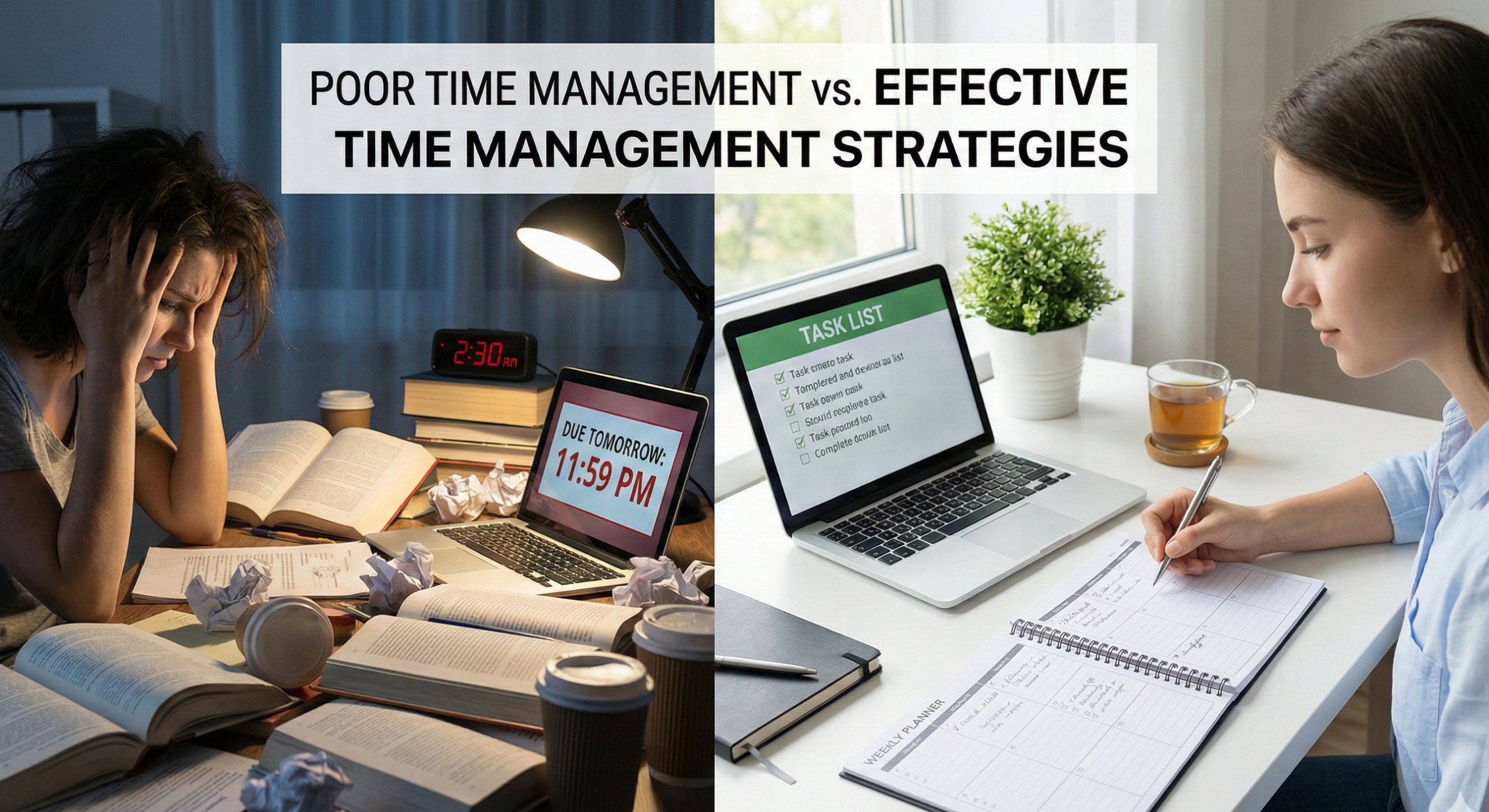
Table of Contents
Why Effective Student Time Management Strategies Are Critical for Your Health
Before we can fix the leak, we have to find the hole in the boat. Why does it feel like time slips through your fingers the moment you step onto a college campus? Understanding the root cause is essential before applying any student time management strategies.
The Myth of the “Time Famine”
Psychologists call it “time famine”—the pervasive feeling that you are constantly running out of minutes. For students, this is often a self-inflicted wound. When you say, “I don’t have time,” what you often mean is, “This task is not a priority right now.” Acknowledging this distinction is the first step toward control. When you shift your language from “I can’t” to “I choose not to right now,” you regain agency over your schedule.
The Transition Shock
If you recently moved from high school to university, you are likely suffering from a loss of structure. In high school, your day was regimented from 8:00 AM to 3:00 PM. Teachers reminded you of due dates daily. Parents likely handled your laundry or meals. Suddenly, you are in college. You might have only three hours of class on a Tuesday. The rest of the day is a blank canvas. Without the scaffolding of a rigid schedule, that free time often dissolves into “grey time”—not fully relaxing, but not fully working. You sit in the library scrolling on your phone, feeling busy but accomplishing nothing. This lack of structure is the primary killer of student productivity.
The Cost of Chaos
Poor management doesn’t just result in a lower GPA. The ripple effects are severe.
- Academic Burnout: Consistently pulling all-nighters depletes your cognitive reserves, leading to a crash mid-semester.
- Increased Anxiety: Living in a state of constant urgency triggers cortisol spikes, keeping you in “fight or flight” mode.
- Social Isolation: When you are always catching up on work on weekends, you miss out on the connection and fun that make student life memorable.
According to the American Psychological Association (APA), time management is a leading stressor for university students. Implementing robust student time management strategies is not just about grades; it is a mental health intervention.
The Psychology of Procrastination: Why We Delay
You have the plan. You have the tools. But you are still staring at the wall. Procrastination is the enemy of all student time management strategies. To beat it, you must understand it.
Understanding “Productive Procrastination”
Have you ever suddenly felt the urge to deep-clean your entire apartment right before an exam? That is productive procrastination. You are doing something, so you don’t feel lazy, but you are avoiding the main thing. Recognize this behavior. If you are organizing your bookshelf instead of writing your thesis, you are procrastinating. This is a common trap where the brain seeks a dopamine hit from completing a small task to avoid the anxiety of a large one.
The Role of Fear
We don’t procrastinate because we are lazy. We procrastinate because we are anxious. Big tasks feel threatening. Your brain wants to protect you from the possibility of failure or the discomfort of hard mental work.
- The Fix: Lower the stakes. Tell yourself, “I am not writing a perfect essay right now. I am just writing a messy, terrible first draft.” Permission to be imperfect removes the paralysis.
![Image: Illustration of a brain choosing between ‘Instant Gratification’ monkey and ‘Rational Decision Maker’. Alt Text: The psychology behind procrastination and student time management strategies]
Top 9 Student Time Management Strategies for Success
Now that we understand the problem, let’s look at the tactical solutions. These are not abstract concepts; they are actionable student time management strategies you can apply immediately.
1. The Pomodoro Technique: Mastering Focus
You sit down to study for three hours. But be honest—how many of those minutes are truly productive? The human brain struggles to maintain intense focus for long periods. Enter the Pomodoro Technique, developed by Francesco Cirillo.
Named after a tomato-shaped kitchen timer, this method breaks work into short, manageable intervals.
- Step 1: Pick a task (e.g., Read Chapter 4).
- Step 2: Set a timer for 25 minutes. Work with zero distractions. No phone, no tabs open.
- Step 3: Take a 5-minute break. Stretch, grab water, or pet your dog.
- Step 4: Repeat.
- Step 5: After four cycles (2 hours), take a longer break (15–30 minutes).
Why it works for students: It lowers the barrier to entry. Studying for “three hours” feels intimidating. Studying for “25 minutes” feels doable. It also prevents the fatigue that usually sets in after an hour of staring at a textbook. You can read more about the origins of this method on the official Pomodoro Technique website.
2. Time Blocking: The Visual Map of Your Day
To-do lists are great, but they have a flaw: they don’t account for when things will happen. You might list ten items that take two hours each, but you only have five free hours in your day.
Time blocking solves this by assigning a specific time slot to every task.
- 9:00 AM – 10:30 AM: Lecture: Organic Chemistry.
- 10:30 AM – 11:30 AM: Review lecture notes immediately (Deep Work).
- 11:30 AM – 12:30 PM: Lunch and social time.
- 12:30 PM – 2:00 PM: Draft History Essay.
When you time block, you are forced to be realistic about how long tasks take. It prevents “Parkinson’s Law,” which states that “work expands to fill the time available for its completion.” If you give yourself all day to write a paper, it will take all day. If you give yourself two hours, you will often finish it in two.
3. The Eisenhower Matrix: Prioritizing Like a Pro
General Dwight D. Eisenhower famously said, “What is important is seldom urgent and what is urgent is seldom important.” Among all student time management strategies, this is the best for decision-making. Draw a square divided into four quadrants:
- Do First (Urgent & Important): Ideally, these are crises (e.g., an assignment due tomorrow). Effective management aims to keep this box empty by planning ahead.
- Schedule (Not Urgent & Important): This is the sweet spot. Studying for an exam two weeks away or starting a term paper early. This is where academic success happens.
- Delegate (Urgent & Not Important): Tasks that need to happen but maybe not by you. In a student context, this might mean study groups where you split the reading load or asking a roommate to handle a chore.
- Delete (Not Urgent & Not Important): Doom-scrolling, rearranging your desk for the tenth time, or excessive gaming. Eliminate these ruthless time-wasters.
4. The Pareto Principle (80/20 Rule)
Vilfredo Pareto observed that 80% of effects come from 20% of causes. In your studies, this means 80% of your grade often comes from 20% of the coursework.
- Apply it: Instead of reading the entire textbook cover-to-cover (low return), focus on the lecture slides, past exams, and tutorial questions (high return). Identify the core concepts that the professor emphasizes and master those first. This is one of the most efficient student time management strategies for exam periods.
5. Eat That Frog
Based on a quote often attributed to Mark Twain: “If it’s your job to eat a frog, it’s best to do it first thing in the morning.” Your “frog” is your hardest, most dreaded task. It’s that 2,000-word essay or the complex calculus problem set. If you leave it for later, it hangs over your head all day, draining your energy. Tackle it first thing when your brain is fresh. Once the frog is eaten, the rest of the day feels like a breeze.
6. The 2-Minute Rule
This is a lifesaver for the small, nagging tasks that clutter your brain, popularized by David Allen’s Getting Things Done. If a task takes less than two minutes to complete, do it immediately.
- Sending an email to a professor? Do it now.
- Registering for a tutorial slot? Do it now.
- Submitting a completed assignment? Do it now.
Letting these tiny tasks pile up creates mental friction. Clearing them instantly keeps your to-do list reserved for meaningful deep work.
7. Spaced Repetition
Cramming is the enemy of time management because it is inefficient. You spend hours reading the same thing but forget it a day later. Spaced repetition involves reviewing material at increasing intervals (1 day, 3 days, 1 week, 1 month). This leverages the “forgetting curve.” By using apps like Anki, you can study for shorter periods each day but retain far more information, freeing up time in the long run.
8. The “No” Strategy
As a student, opportunities are everywhere—parties, clubs, extra projects. But every time you say “yes” to something minor, you are saying “no” to your priorities. Learning to say, “I can’t commit to this right now because I need to focus on my finals,” is a powerful skill. Guard your time fiercely.
9. Strategic Rest and Sleep Hygiene
This might seem counterintuitive, but one of the best student time management strategies is knowing when not to work.
- The Myth of the All-Nighter: Culture often glorifies the sleepless student, but science disagrees. Sleep is when your brain consolidates memory. If you study for five hours and then sleep for two, you will retain less than if you studied for three hours and slept for eight.
- Active vs. Passive Breaks: When you take a break, what do you do? If you immediately scroll through TikTok or Instagram, you aren’t actually resting. You are blasting your brain with dopamine and new information. Try Active Recovery instead: go for a walk, do pushups, or meditate.
Digital vs. Analog: Essential Tools for Students
In the battle of student time management strategies, the tools you use can make or break your workflow. Should you go high-tech or old-school?
The Case for Digital Tools
If you are tech-savvy and carry your phone everywhere, apps can be powerful allies.
- Google Calendar: Essential for the “big picture.” Put your class schedule, exam dates, and social events here. Use color-coding (e.g., Red for Exams, Blue for Classes, Green for Fun). Set reminders so you never miss a deadline.
- Notion: The all-in-one workspace. You can build databases for your assignments, take notes, and track habits. It has a steep learning curve but offers unmatched customization. Check out Notion for Students.
- Forest App: Gamify your focus. When you start a timer, a digital tree starts growing. If you exit the app to check Instagram, your tree dies. It sounds silly, but the desire to keep your virtual forest alive is surprisingly motivating.
The Power of Analog
Don’t underestimate pen and paper.
- Bullet Journaling (BuJo): This method allows you to create a custom planner in a blank notebook. The act of writing down tasks by hand helps commit them to memory. It separates your planning from the distractions of the internet.
- Physical Planners: A simple day planner sitting open on your desk is a constant visual reminder of what needs to be done. Unlike an app, you can’t “minimize” a physical book.
The Hybrid Method
For most students, a mix is best. Use Google Calendar for appointments and alerts (because a paper planner can’t beep at you). Use a physical sticky note or notebook for your daily “Top 3 Priorities.” This keeps your daily focus tangible while ensuring you don’t miss long-term events.
Implementing Student Time Management Strategies for Working Students
If you are juggling a part-time job alongside your degree, your margin for error is razor-thin. Standard student time management strategies need to be adapted for your busy reality.
Front-Loading Your Week
Use your weekends effectively. Sunday is not just a rest day; it is a prep day. Try to do 100% of your reading for the upcoming week on Sunday. This ensures that when you come home tired from a shift on Wednesday, you don’t have to do heavy cognitive work—you just need to review or attend class.
Communication is Key
Be transparent with your employer. Provide them with your exam dates as soon as the semester starts. Most managers are willing to be flexible if you give them two months’ notice, but they will be less accommodating if you ask for time off two days before the exam.
Micro-Study Sessions
You may not have 4-hour blocks of free time. You must learn to use the 15 minutes on the bus, or the 20 minutes before your shift starts. Use flashcards or listen to recorded lectures during these gaps. These “dead times” can add up to 5-10 hours of extra study time per week.
![Image: A student looking at a schedule on a tablet while wearing a work apron. Alt Text: Balancing work and study using student time management strategies]
Conclusion: Reclaim Your Life Today
Time management is not about turning yourself into a productivity robot. It is not about squeezing every second of joy out of your life so you can study more. It is the exact opposite.
By implementing these student time management strategies, you are creating a container for your work so that it doesn’t spill over into your life. When you time block effectively, you can close your books at 6:00 PM and go out with friends guilt-free, knowing your work is done. You can sleep eight hours knowing you have a plan for tomorrow.
You don’t have to overhaul your entire life overnight. That is a recipe for failure. Start small. Pick one strategy from this guide—maybe it’s the Pomodoro method, or maybe it’s just buying a physical planner. Try it for one week. Commit to it. You will be surprised at how quickly the chaos subsides and clarity takes its place.
The semester is going to pass anyway. You can either spend it frantically chasing deadlines, or you can step into the driver’s seat. The choice is yours.
FAQ: Common Questions About Student Time Management Strategies
1. How long does it take to see results from these strategies?
Most students notice a difference immediately after implementing student time management strategies like the Pomodoro technique or the 2-Minute Rule. However, building a consistent habit usually takes about 21 to 66 days. Be patient with yourself.
2. What if I fall off the wagon and stop planning?
This is normal. Life happens. If you miss a day or a week of planning, don’t abandon the system. Just open your calendar and plan tomorrow. Resilience is more important than perfection.
3. Can I use these strategies for group projects?
Absolutely. Tools like the Eisenhower Matrix are excellent for dividing group work. You can also use shared digital tools like Google Docs or Trello to assign tasks and deadlines to group members, ensuring everyone stays on track.
4. Are these strategies useful for high school students too?
Yes, while this guide focuses on the autonomy of college, high school students who learn these student time management strategies early will have a massive advantage when they eventually transition to higher education.