Hard Skills vs. Soft Skills: Understanding the Difference for Career Success 2026
In today’s professional landscape, a resume packed with degrees is no longer enough. Whether you are an HR manager looking for top talent or a candidate aiming to climb the career ladder, you have undoubtedly heard these two buzzwords: Hard Skills and Soft Skills.
But beyond the jargon, what is the real difference between these two skill sets? And more importantly, which one weighs more heavily when it comes to long-term career success?
In this article, we will demystify the “Technical vs. Behavioral” debate and explain why the future belongs to those who can master both.
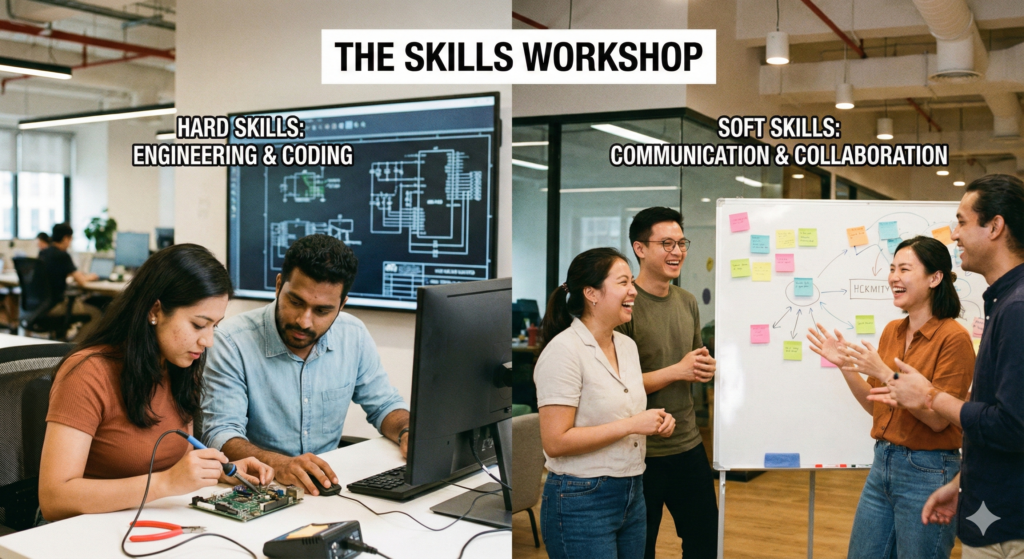
Table of Contents
1. Hard Skills: The Technical Toolbox (The “What”)
“Hard Skills” represent what is traditionally known as technical know-how. These are tangible, quantifiable abilities that are specific to a job or industry.
Generally, these skills are acquired through formal education, training programs, certifications, or on-the-job experience. They are easy to define and measure. If you can take a test on it and get a score, it is likely a Hard Skill.
Concrete examples of Hard Skills:
- Programming: Mastery of Python, Java, or HTML.
- Languages: Fluency in Spanish, French, or Mandarin.
- Marketing: Managing Google Ads campaigns or SEO technical auditing.
- Finance: Bookkeeping, financial forecasting, or auditing.
- Design: Proficiency in the Adobe Suite (Photoshop, Illustrator).
Think of Hard Skills as your “ticket to entry.” They validate that you are technically capable of performing the daily tasks required by the job description.
2. Soft Skills: The Art of Human Interaction (The “How”)
On the other side of the spectrum, “Soft Skills” refer to interpersonal skills. These are behavioral, social, and situational traits. They define how you work and interact with others, rather than what you know technically.
Unlike technical skills, Soft Skills are harder to measure. There is no universal degree for “patience” or “empathy,” yet these are often the qualities that determine an employee’s longevity and impact within a company.
Essential examples of Soft Skills:
- Communication: Active listening, public speaking, and writing clarity.
- Emotional Intelligence: Empathy, self-awareness, and stress management.
- Teamwork: Collaboration and conflict resolution.
- Adaptability: The ability to pivot when plans change.
- Leadership: Motivating and guiding a team toward a goal.
3. The Showdown: Key Differences
To visualize the difference, imagine an iceberg. Hard Skills are the visible tip (what you see on a CV), while Soft Skills are the massive portion underwater (what you discover once the person is hired).
Here is a comparison table to help break it down:
| Feature | Hard Skills (Technical) | Soft Skills (Behavioral) |
| Nature | Technical know-how | Personality traits & behaviors |
| Acquisition | Degrees, books, courses | Life experience, coaching, introspection |
| Measurement | Tests, exams, portfolios | Observation, 360° feedback, scenarios |
| Stability | Change frequently (tech updates) | Durable and transferable to any job |
| Focus | Machine/Task-oriented | Human/People-oriented |
4. Why “Power Skills” (Hybrid) Are the Future
For a long time, companies prioritized technical prowess above all else. Today, the trend is shifting. According to data from platforms like LinkedIn, Soft Skills are now considered just as important—if not more so—than Hard Skills.
Why? Because technical skills have a “shelf life.” A coding language or a software tool can become obsolete in five years. However, the ability to learn (curiosity), communicate complex ideas, and solve problems will remain vital regardless of technological changes.
However, we shouldn’t pit them against each other. The ideal profile is hybrid.
- Without Hard Skills, you cannot do the work.
- Without Soft Skills, you cannot work effectively with others or lead.
The Golden Rule of HR: “You are hired for your Hard Skills, but you are fired (or promoted) for your Soft Skills.”
5. How to Develop Both Skill Sets
The good news is that both types of skills can be learned, though the methods differ.
To Boost Your Hard Skills:
Focus on structured learning. Online courses (MOOCs), technical workshops, specialized reading, and certifications are highly effective. Repetition and practice are key.
To Improve Your Soft Skills:
The process requires more introspection and practice in social settings.
- Seek Feedback: Ask colleagues or mentors about your blind spots (e.g., “Do I interrupt people during meetings?”).
- Step Out of Your Comfort Zone: Volunteer to lead a project or present to a client.
- Find a Mentor or Coach: Work with someone who can help you navigate workplace dynamics and emotional intelligence.
Whether you are an organization looking to upskill your workforce or an individual managing your career path, the goal is not to choose between Hard and Soft Skills, but to create a synergy between them.
In the age of Artificial Intelligence, many technical tasks will eventually be automated. Therefore, your humanity—your creativity, empathy, and adaptability—will become your true value proposition in the job market.