Prepare for Interview Success: 10 Powerful Steps to Get Hired
To prepare for interview scenarios effectively is the single most defining factor between candidates who get an offer and those who get a rejection email.
Do you remember that specific feeling—the one where your palm sweats against the cool metal of a door handle, or the way your heart hammers against your ribs right before a Zoom call connects? We have all been there. It is the sinking realization that you walked out of a meeting leaving the best parts of your professional story untold. You know you were the right person for the job, but in the heat of the moment, the words just didn’t land.
It isn’t a lack of talent that usually holds you back; it is often a lack of specific, strategic preparation.
When you prepare for interview questions and logistics properly, it is an act of self-advocacy. It is the process of translating your hard-earned late nights, your project wins, and your unique skills into a narrative that a hiring manager can believe in. This guide isn’t just about helping you get a job; it is about ensuring you walk into that room—or log into that meeting—with the quiet, unshakable confidence that comes from knowing you are ready.
Let’s turn that anxiety into your competitive advantage. Here is your ultimate roadmap.

Table of Contents
1. Why You Must Prepare for Interview Research Thoroughly
Before you even think about rehearsing an answer, you need to know exactly who you are talking to. Walking into an interview without deep knowledge of the company is like trying to navigate a new city without a map—you might get lucky, but you will likely get lost.
Most candidates will glance at the homepage and memorize the CEO’s name. To stand out, you need to go deeper when you prepare for interview discussions.
The “About Us” Deep Dive
Don’t just skim the mission statement; analyze it. If a company claims to value “innovation,” look for evidence of that in their recent projects. If they talk about “sustainability,” find out what initiatives they have actually launched.
- Identify the Pain Points: What problems is this company trying to solve right now? Are they expanding into a new market? Are they recovering from a PR crisis? If you can position yourself as the solution to their specific headache, you become indispensable.
- Core Values Alignment: When you prepare for interview answers, align your personal stories with their values. If they prioritize “collaboration,” make sure your behavioral answers highlight teamwork over solitary genius.
The Social Media Audit
A corporate website is polished and static. Social media is where the company’s actual personality lives. Check their LinkedIn, Twitter (X), and Instagram pages.
- Tone of Voice: Do they use emojis and casual language, or are they strictly formal? Mirroring this tone can help build instant rapport.
- Recent Wins: Did they just win an industry award? Did they host a charity event? Mentioning these specifics (“I saw on LinkedIn that your team just wrapped up the Alpha Project…”) proves you are paying attention.
Check Financial Health
You don’t need to be an accountant, but doing a quick check on Google Finance or reading their latest press releases about quarterly earnings shows business acumen. Are they growing? Did they just acquire another company? This context allows you to ask high-level questions that impress senior managers.
2. Prepare for Interview Questions: The “Big Three”
While you can’t predict every curveball, 80% of an interview usually consists of the same core questions. Stumbling here is an unforced error. You need to have polished, natural-sounding responses ready to go.
“Tell Me About Yourself”
This is almost always the opener, yet it is the place where most candidates ramble. Do not give a chronological history of your life starting from kindergarten. When you prepare for interview introductions, use the Past-Present-Future framework:
- Past: Briefly touch on your background and relevant education.
- Present: Describe your current role and a major recent accomplishment.
- Future: Explain why you are here today and how this specific role aligns with your career trajectory.
“Why Do You Want to Work Here?”
If your answer is “I need a job” or “The pay is good,” you have already lost. This is where your research pays off. Connect the dots between their mission and your passion.
- Example: “I’ve followed your work in renewable energy for years. My background in sustainable engineering makes me eager to contribute to a team that is actually solving the climate crisis, not just talking about it.”
“What Are Your Greatest Strengths and Weaknesses?”
- Strengths: Don’t just pick an adjective (“I’m a hard worker”). Pick a strength that solves a problem for them, and back it up with a mini-story.
- Weaknesses: Avoid the humble-brag (“I work too hard” or “I’m a perfectionist”). It feels dishonest. Instead, choose a real weakness that isn’t fatal to the job, and immediately follow up with how you are working to fix it.
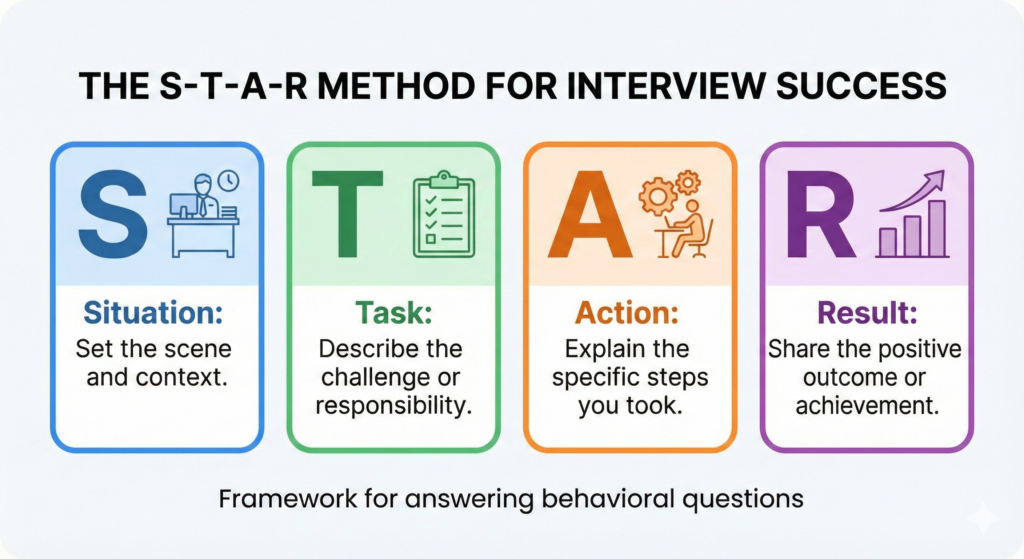
3. Master the STAR Method to Prepare for Interview Stories
This is the technical core of your preparation. Behavioral questions are the ones that start with “Tell me about a time when…” or “Give me an example of…”
The interviewer is operating on the logic that past behavior predicts future performance. To answer these effectively without rambling, you must prepare for interview storytelling using the STAR Method.
Situation (S)
Set the scene efficiently. Keep this brief—no more than 2-3 sentences.
- Bad: “So, it was a Tuesday, and the coffee machine was broken, and my boss was in a bad mood…”
- Good: “In my previous role as a Project Manager, our team was facing a strict deadline for a client launch that had been moved up by two weeks.”
Task (T)
Describe your specific responsibility in that situation. What were you tasked with doing?
- Example: “I needed to reorganize the workflow to meet the new deadline without burning out the team or compromising quality.”
Action (A)
This is the meat of the answer. Describe the specific steps you took. A common mistake is using “We” too much. The interviewer is hiring you, not your team. Use “I.”
- Example: “I initiated a daily stand-up meeting to identify blockers. I re-allocated resources from non-urgent tasks and personally negotiated a scope reduction with the client to focus on core features first.”
Result (R)
End with a bang. Quantifiable results are always best.
- Example: “As a result, we delivered the project two days early. The client was so satisfied they signed a retainer contract worth $50,000.”
Action Item: Before your interview, write down 5 “Power Stories” from your career. Identify which stories can be adapted to fit different questions (e.g., a story about a difficult client can answer questions about conflict, communication, or problem-solving).
4. Prepare for Interview Success with Mock Sessions
Reading about how to swim is different from jumping in the pool. You cannot just “think through” your answers; you have to speak them out loud. Your brain processes thoughts differently than your mouth processes speech.
Record Yourself
It feels awkward, but recording yourself on your smartphone is the fastest way to improve when you prepare for interview delivery. Watch the playback and analyze:
- Filler Words: Are you saying “um,” “like,” or “you know” every five seconds?
- Body Language: Are you slouching? Fidgeting?
- Pacing: Are you talking too fast out of nervousness?
The Peer Review
Ask a friend or mentor to conduct a mock interview. Give them the job description and a list of tough questions. Ask them to be critical. You need honest feedback now, not after you get the rejection email.
Leverage AI Tools
If you don’t have a practice partner, use modern tools like ChatGPT or specific interview AI coaches. You can paste the job description into the tool and ask it to generate specific interview questions for you.
5. Prepare Your “Reverse Interview” Questions
Toward the end of the session, the interviewer will ask, “Do you have any questions for us?” Saying “No, I think you covered everything” is a missed opportunity. It can signal a lack of curiosity or engagement.
When you prepare for interview discussions, write down a list of high-impact questions that show you are thinking critically about the role.
High-Impact Questions to Ask:
- “What does success look like in this role within the first 90 days?” (Shows you are goal-oriented).
- “Can you tell me about the team dynamic and how you handle conflict?” (Shows emotional intelligence).
- “What is the biggest challenge the department is currently facing?” (Demonstrates you are a problem solver).
- “How has the company evolved since you joined?” (Gets the interviewer talking about themselves, which builds connection).
6. The Logistics: Attire, Tech, and Environment
You have done the mental work; now ensure the physical environment doesn’t betray you. In the age of hybrid work, the logistics of an interview have become more complex. You must prepare for interview environments meticulously.
For Virtual Interviews
- The Tech Check: Test your internet connection, microphone, and camera 30 minutes before the start time. Have a backup plan (like a mobile hotspot) ready.
- The Background: Ensure your background is clean and professional. A pile of laundry or an unmade bed in the frame screams “disorganized.”
- Lighting: Never sit with a window behind you; you will look like a silhouette. Face the window or a lamp so your face is illuminated clearly.
- Eye Contact: Look at the camera lens, not the face on the screen. This simulates eye contact for the person on the other side.
For In-Person Interviews
- The Route: Map your travel time. Add 20 minutes for traffic or parking issues. Arriving late is often an automatic disqualification.
- What to Bring: Bring multiple hard copies of your resume (one for each interviewer), a notebook, and a pen.
- The Dress Code: It is always better to be slightly overdressed than underdressed. Even if the company has a “casual” culture, wearing a sharp button-down or a blazer shows respect for the occasion.
7. Psychology and Body Language
When you prepare for interview scenarios, do not neglect the non-verbal cues. Research suggests that communication is 55% body language, 38% tone of voice, and only 7% actual words.
The Power Pose
Before the interview (not during!), try “power posing”—standing in a posture of confidence (like hands on hips) for two minutes. Psychologist Amy Cuddy’s research suggests this can lower cortisol (stress hormone) and raise testosterone (confidence hormone).
During the Interview
- The Handshake: If in person, offer a firm (but not bone-crushing) handshake.
- Sitting: Sit up straight and lean slightly forward. This indicates interest and engagement. Leaning back can look arrogant or disinterested.
- Hand Gestures: Use your hands to emphasize points, but keep them within the “box” (from your shoulders to your waist). Avoid crossing your arms, which signals defensiveness.
8. Handling the “Curveball” Questions
Even the best preparation can’t predict everything. Sometimes, interviewers ask brain teasers or stress questions to see how you react under pressure.
Common Curveballs:
- “How many tennis balls fit in a Boeing 747?”
- “If you were a color, which one would you be?”
How to Handle Them: Don’t panic about the “right” answer. These questions assess your critical thinking process, not your knowledge of tennis balls. Talk through your logic out loud.
- Say: “That is an interesting question. I would start by estimating the volume of the plane, then the volume of a ball…”
It is also perfectly acceptable to say, “That is a great question. I don’t have the specific data on hand right now, but I can tell you how I would find it.”
9. Prepare for Interview Follow-Up
The interview isn’t over when you hang up the phone or walk out the door. The follow-up is the final step in how you prepare for interview completion.
The Thank You Note
Send a personalized email within 24 hours to everyone you interviewed with.
- Subject: Thank You – [Your Name] – [Job Title]
- Content: Thank them for their time, mention a specific topic you discussed (to show you were listening), and reiterate your excitement for the role.
- Why it matters: In a tight race between two qualified candidates, the one who sent a gracious thank-you note often gets the edge.
10. Managing Pre-Interview Anxiety
Finally, the most overlooked aspect when you prepare for interview days is your mental state. Anxiety can cloud your memory and make you jittery.
- Breathing Techniques: Use the “Box Breathing” method (inhale for 4, hold for 4, exhale for 4, hold for 4) to calm your nervous system immediately before the interview.
- Visualize Success: Athletes use visualization to improve performance; you can too. Spend five minutes visualizing the interview going well—smiling, answering questions confidently, and connecting with the interviewer.
- The “Excitement” Reframing: Anxiety and excitement are physiologically very similar (high heart rate, butterflies). Instead of telling yourself “I am nervous,” say “I am excited.” It tricks your brain into a positive state of arousal.
Conclusion: You Are Ready
If you follow these steps, the feeling you have walking into the interview won’t be fear—it will be adrenaline. And there is a big difference.
Preparation buys you freedom. When you prepare for interview questions thoroughly, you aren’t scrambling to think of an answer. You have the mental bandwidth to actually listen, to engage, and to let your personality shine through. You stop trying to “survive” the interview and start participating in a conversation about your future.
Remember, an interview is a two-way street. They are assessing you, but you are also assessing them. By doing the work to prepare for interview logistics, you are proving to them—and to yourself—that you are a professional who takes their career seriously.
Take a deep breath. You have done the research. You have practiced the stories. You look the part. Now, go in there and get what you deserve.
FAQ: Frequently Asked Questions
Q1: How long should I take to prepare for interview sessions? There is no single rule, but a good benchmark is to dedicate at least 3 to 5 days of focused effort once the interview is scheduled. Use this time to research the company, practice your STAR stories, and rest. If you have less time, focus on the “Big Three”: Company Mission, “Tell me about yourself,” and “Why do you want this job?”
Q2: What is the best way to prepare for interview situations if I only have 24 hours? Prioritize ruthlessly. Spend 1 hour researching the company’s recent news and website. Spend 2 hours practicing your behavioral answers (STAR method). Spend 30 minutes preparing your outfit and tech. Get a good night’s sleep—being rested is better than cramming all night and showing up exhausted.
Q3: How do I prepare for interview questions with no experience? If you are a fresh graduate or changing careers, focus on transferrable skills. Use examples from university projects, volunteer work, or internships. Highlight soft skills like adaptability, quick learning, and work ethic. Your attitude and willingness to learn are your biggest assets here.
Q4: Is it okay to bring notes when I prepare for interview meetings? Absolutely. Bringing a notebook with prepared questions and a few bullet points about your achievements shows that you are organized. However, do not read from your notes verbatim. Use them as a quick reference if you get stuck.
Q5: How do I handle a question I don’t know the answer to? Don’t panic and don’t lie. It is perfectly acceptable to say, “That is a great question. I don’t have the specific data on hand right now, but based on my experience, I would approach it by…” Or simply ask for a moment to think. Silence is better than a bad, rambled answer.
What’s Your Next Move?
Now that you have the roadmap to prepare for interview success, it is time to do the work. Don’t just bookmark this article—start your research document right now. Open a new tab, search for your dream company, and begin building your case.
Do you have a tough interview question you are struggling to answer? Drop it in the comments below, and let’s workshop the perfect response together!