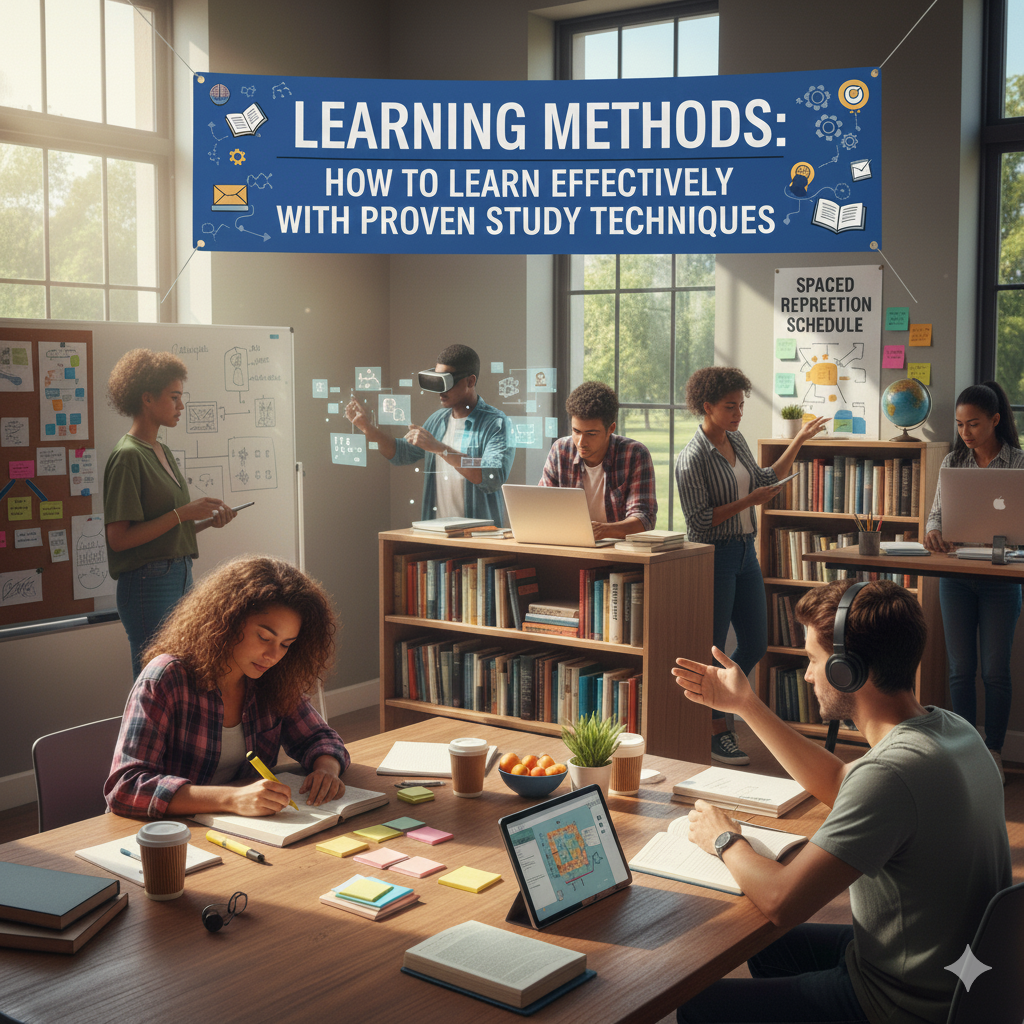
Learning Methods: How to Learn Effectively with Proven Study Techniques
Many people wonder how to learn effectively and what the best ways to learn are. In education, we often talk about learning methods or learning styles – the idea that some students grasp information visually while others prefer listening or hands-on activity. It’s tempting to think each person has a fixed style and that teaching to it will improve learning. However, research shows this isn’t supported. For example, one major review found no evidence that tailoring instruction to a self-reported style (visual, auditory, etc.) boosts outcomes. In fact, combining multiple modalities tends to work better: presenting both images and words engages learners more deeply and improves retention. In short, knowing your preference can help you choose strategies, but the most effective learning often comes from using all channels and proven techniques.

To organize the many approaches, we’ll review each major learning method below, noting how it works, examples, plus pros and cons. We’ll also highlight evidence-based study techniques (like spaced repetition and retrieval practice) that benefit all learners. For more on practical tips, see our guide on effective study habits.
Table of Contents
Sensory Learning Styles (VARK Model)
One popular way to categorize learners is the VARK model (Visual, Auditory, Reading/Writing, Kinesthetic). Each “style” describes a preferred sensory input:
Visual Learning
Visual learners understand best through pictures, charts, videos, and other graphics. They form mental images and often remember diagrams more easily than spoken words. In practice, they benefit from flowcharts, infographics, and color-coded notes.
- Pros: Clarifies complex ideas with images; taps into visual memory; can reveal patterns (e.g. graphs, mind maps).
- Cons: May miss fine details if over-relying on pictures; not ideal for abstract or sequential info alone.
- Tip: Pair visuals with words. Cognitive science shows that dual coding (combining visual + verbal information) doubles retention. In other words, if you draw a concept and explain it aloud or in writing, you’ll likely remember it far longer than by just listening or just viewing alone.
Auditory Learning
Auditory learners grasp material best through listening and speaking. They excel when information is presented in lectures, discussions, or audio formats (like podcasts). Hearing stories or explanations helps them encode knowledge.
- Pros: Great for language-based material (lectures, discussions); can learn on the go (e.g. audiobooks); improves recall by verbal repetition.
- Cons: May struggle with content without spoken cues; background noise or multi-tasking can distract; passive listening alone yields weaker retention than active methods.
- Tip: Engage more senses: studies found that students prompted to visualize information as well as listening retained twice as much as those who only listened. In other words, even auditory learners benefit enormously by adding a visual or written element.
Reading/Writing Learning
Learners in this group prefer text: reading textbooks, articles, and writing notes or essays. They learn by writing summaries, rewriting concepts in their own words, and reading explanations. This is a common preference in traditional schooling.
- Pros: Engages analytical processing (reading and writing); good for detailed note-taking and research; supports organization (outlines, lists).
- Cons: Can be slow (takes time to read and write); less sensory variety (risk of fatigue); may lead to passive skimming if not combined with active review.
- Tip: Use the writing process as active study. Instead of passively re-reading, turn notes into practice (e.g. flashcards or teaching another). Spaced writing and review helps turn transient notes into durable knowledge (see Spaced Repetition below).
Kinesthetic (Hands-On) Learning
Kinesthetic learners thrive on movement, touch, and real-world practice. They learn best by doing – for example, conducting experiments, building models, role-playing, or going on field trips. When their bodies engage, their brains encode the learning.
- Pros: Engages attention through action; links concepts to real experience; often more fun and memorable. Research shows physical movement (even simple breaks or gestures) can boost focus and recalll. Hands-on activities help learners “reset” mentally and absorb information more deeply.
- Cons: Requires resources (labs, equipment, space); not always possible for every subject; some learners may find constant activity distracting if not managed well.
- Tip: Incorporate activities into study. For example, use physical objects (puzzles, flashcards), take short breaks to move, or simulate scenarios. Doing practice problems or teaching a friend engages kinesthetic memory, which often reinforces learning better than passive reading alone.
Evidence and Comparison: While identifying as a visual or kinesthetic learner can guide your approach, remember the research: no single style guarantees better learning. One experiment had students process information either by listening alone or by listening and using mental imagery; those who used both modalities remembered twice as much. Likewise, a comprehensive review concludes that students do slightly better with multimedia (online/blended) instruction than with purely face-to-face methods. In practice, try combining styles. For example, listen to a lecture and draw a diagram of the concept; read a chapter then explain it aloud; or take notes and test yourself.
Online Learning
Online learning (e-learning, virtual classes, MOOCs, etc.) lets students study anywhere with internet access. It can be fully online or blended (mixing in-person and online).
- Pros: Flexible schedule and pacing; access to diverse resources (videos, quizzes, forums); scalable (huge courses reach many learners); often interactive (simulations, quizzes). Notably, a large meta-analysis found that students in online courses performed modestly better on average than those in traditional classes. When online elements are added to in-person courses, outcomes often improve further (though partly because courses provide extra learning time).
- Cons: Less face-to-face interaction; requires self-discipline and tech skills; potential technical glitches; some students feel isolated. Success depends on good course design: multimedia lectures, immediate feedback, and community features can boost motivation.
Tip: For effective online study, use active strategies: pause videos to self-quiz, use discussion forums to explain concepts, and set a routine. The key to “best ways to learn” online is the same as offline: engage with the material, test yourself, and space out your study (see Spaced Repetition below).
Self-Directed Learning
Self-directed learning means you set the goals, find resources, and judge your progress. It’s common in adult or professional learning: you decide what to learn and how (e.g., teaching yourself a language or skill).
- Pros: Total autonomy and personalization; learn at your own pace; extremely motivating if the topic is relevant; develops planning and metacognitive skills. According to adult learning theory, self-direction is a hallmark of effective adult education.
- Cons: Can be challenging without guidance; learners must be highly self-motivated and organized; risk of gaps if you miss key fundamentals. Novices in a subject often need structure (such as a class or mentor) before they can succeed on their own.
Tip: Structure your self-study. Set clear objectives, break topics into manageable units, and use resources like online courses or study groups as needed. Even if you learn independently, apply active techniques: create a study schedule, take quizzes (retrieval practice), and review material using spaced intervals.
Collaborative Learning
Collaborative learning involves studying in groups or teams – for example, group projects, peer tutoring, or study groups. It leverages social interaction and peer support.
- Pros: Deepens understanding by explaining concepts to others; exposes you to different viewpoints; builds communication and teamwork skills. Students often report that group activities make learning more engaging. For instance, one report found about 78% of students in active, hands-on courses noted significant gains in collaboration and communication skills. Working with peers also creates accountability.
- Cons: Group dynamics can be tricky: unequal participation (“free-riding”), conflicts, or off-topic chatter. Scheduling meetings can be hard, and learning may stall if the group is uncoordinated. In some cases, group work can distract from content if not well structured by a teacher.
Tip: To benefit from group study, set clear roles or agendas. Use collaborative tools (shared documents, forums), quiz each other, or teach a concept to the group. Keep group sessions focused on problems and explanations, not just casual talk.
Experiential (Active) Learning
Experiential learning means learning by doing in real contexts. This includes labs, internships, projects, simulations, field trips, or service learning. It’s closely related to active learning, which involves any activity where students apply, analyze, or create (rather than passively listen).
- Pros: Highly engaging and memorable. By directly applying concepts, students form stronger connections and improve retention. Kolb’s Experiential Learning Theory emphasizes this: knowledge is created through experience and reflection. Research suggests experiential approaches boost academic performance and skills: for example, one survey by the National Society for Experiential Education found an average 20% improvement in student performance from hands-on courses. Another study reported that 85% of students in experiential programs made notable gains in critical thinking and problem-solving. Real-world practice also develops soft skills like teamwork and leadership as byproducts.
- Cons: Resource-intensive: requires time, materials, or special settings. Not every topic can be learned experientially (some abstract theory may not have a simple real-world demo). Also, without reflection, hands-on tasks can become a busywork without deep learning.
Tip: Whenever possible, link theory to practice. Do experiments, build models, or simulate scenarios. Reflect on these activities (write journals or discuss what you learned). If you can “teach” your experience to someone else, you further solidify the learning.
Spaced Repetition and Active Recall
Spaced repetition is a proven study technique, not a “style,” but it’s crucial to mention. It means reviewing information at increasing intervals (e.g. 1 day later, then 3 days, then a week, etc.) instead of cramming. This combats the forgetting curve and moves knowledge into long-term memory.
- Pros: Dramatically improves retention. For example, a recent large study with 26,000 physicians found that even simple spaced quizzes led to significantly better recall than no spacing (retention rates ~58% vs 43%). Another new study showed that active retrieval practice (self-quizzing) outperforms just restudying notes – it boosted both memory and the ability to apply concepts. In practice, using flashcards with a spaced schedule (or apps like Anki) means you keep reviewing facts just as you’re about to forget them.
- Cons: Requires planning or tools (flashcards, apps). It may feel slow at first because you revisit old material instead of immediately learning something new.
- Tip: Integrate retrieval practice into your routine. Test yourself with flashcards, practice problems, or by teaching someone else. Then review missed items on a spaced schedule. Over time this yields the “best way to learn” for durable mastery.
Pros and Cons of Each Method
No single method is best for all content and people. Each approach has strengths:
- Visual/Auditory/Read-Write/Kinesthetic: These preferences can guide how you study. Visual aids help with memory; listening is convenient; writing notes reinforces text; hands-on makes abstract ideas concrete. But on their own, none guarantees success – using multiple senses together works best.
- Online vs. In-Person: Online learning offers flexibility and a wealth of multimedia, often matching or slightly exceeding traditional lecture outcomes. In-class learning provides structure and live interaction. Blended approaches often yield superior results (so-called “flipped classroom”). The drawback of online is less face-to-face feedback; the drawback of purely in-person is less scheduling flexibility.
- Self-Directed: Freedom to choose topics and pace can maximize motivation, but it also means you must create your own structure. Learners who aren’t used to setting goals may struggle. Combining self-study with accountability (a coach, group, or deadlines) can mitigate this.
- Collaborative: Explaining ideas to peers forces active engagement and exposes gaps in understanding. However, group work requires coordination and fair contribution. To use it well, define clear group goals and roles.
- Experiential: Immersion in real tasks makes learning stick and builds practical skills. But it needs time and guidance. Pair experiences with reflection (e.g. summarize or debrief after an activity).
- Spaced Repetition: Possibly the most universally effective study technique. It doesn’t matter whether you’re a “visual” or “auditory” learner – spaced retrieval works across the board. (Indeed, one expert notes that active learning, spaced repetition, and retrieval practice benefit all learners.) The only “con” is that it’s not intuitive at first; you must resist cramming for lasting memory.
Conclusion
In summary, understanding different learning methods helps you mix strategies for maximum effect. There are many types of learning styles (visual, auditory, kinesthetic, etc.), but research warns against relying on any single style. Instead, use evidence-based study techniques: combine modalities, engage actively, and review over time. For example, listen to a lecture and sketch a diagram; read your notes and quiz yourself a day later; do a group project and write a summary after. These methods complement each other.
Ultimately, the best approach is tailored and varied. Try different techniques and pay attention to what boosts your understanding and retention. Focus on habits like active recall, spaced practice, and hands-on projects – these are consistently shown to improve learning for everyone. For more tips on studying effectively, check out our guide on effective study habits and incorporate strategies from multiple methods above. By being an active, engaged learner and using proven study techniques, you’ll optimize your learning no matter the subject.
Meta Description: Explore different learning methods (visual, auditory, kinesthetic, online, experiential, etc.) and study techniques for how to learn effectively. This comprehensive guide on learning styles and study strategies covers the pros, cons, and research-backed tips (like spaced repetition and active recall) for students, teachers, and professionals.