Diploma vs Certification: Education and Professional Qualifications in 2026
Table of Contents
Definitions
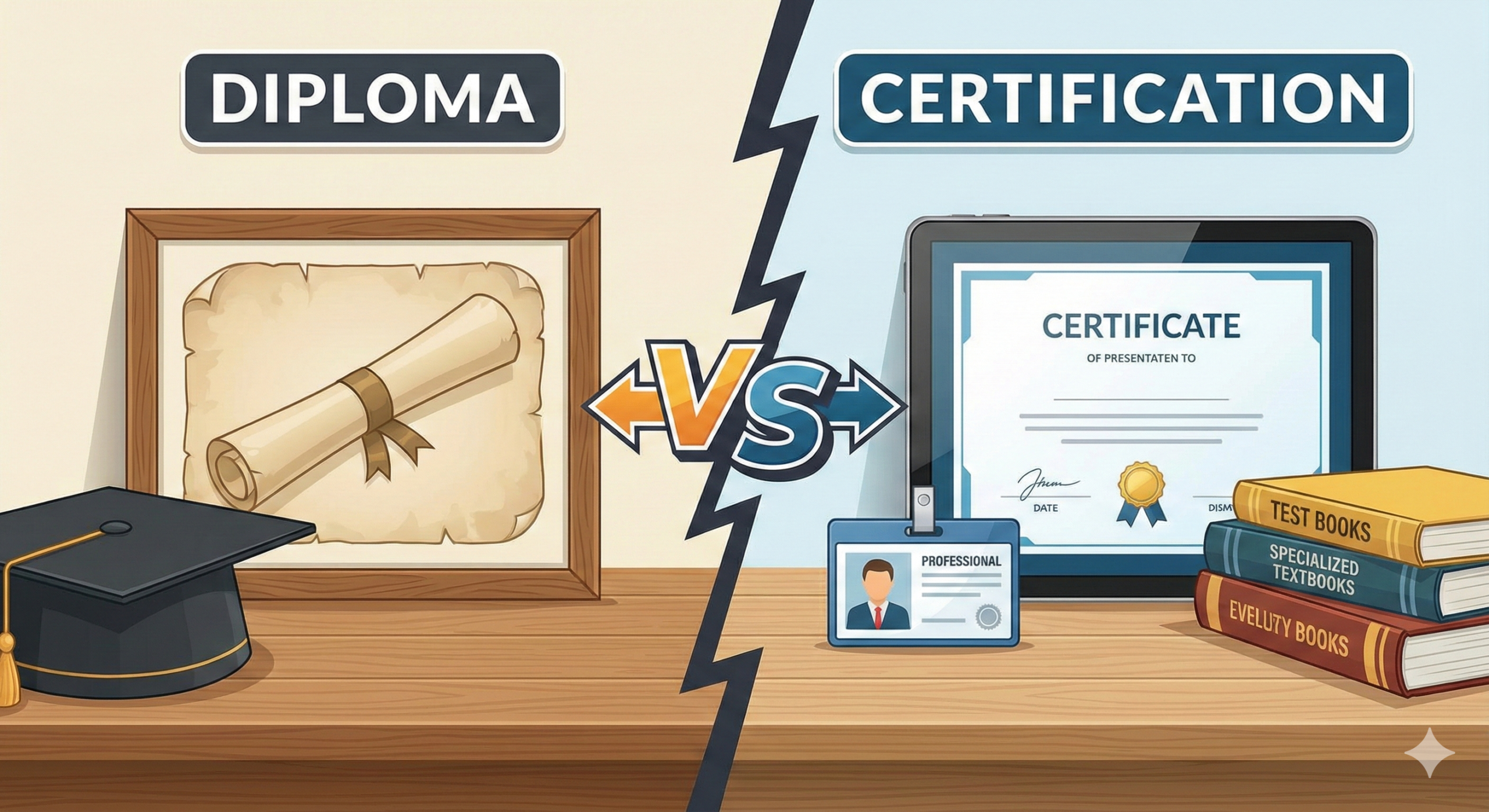
Diploma: An academic or vocational qualification awarded by an educational institution upon successful completion of a course or programme. Diplomas are usually shorter, skill-focused credentials (often 1–3 years) that emphasize practical knowledge in a specific field. For example, polytechnics and technical institutes offer diplomas in fields like engineering, design or nursing. In some countries (e.g. the US), a “diploma” can also refer to the physical document certifying an academic degree or high school graduation.
Certification: A credential awarded by a professional body or certifying organization after demonstration of specific skills or knowledge, often through an exam or assessment. Certifications are typically short-term (ranging from a few weeks to a few months) and focus narrowly on job-relevant competencies. They are usually issued by industry associations, training institutes or exam providers (e.g. PMI for the PMP, (ISC)² for CISSP) to signal mastery in a particular domain. Certification verifies competency in a skill, whereas a diploma certifies completion of an educational programme.
Duration and Requirements
Diploma: Typically requires 1–3 years of full-time study (though durations vary by field and country). Entry usually demands prior schooling (such as a high school diploma or equivalent) and passing required coursework or exams. For example, many college diplomas require completion of secondary education (grades 10–12). Diplomas involve a fixed curriculum of classes and may include a final practical project or exam.
Certification: Usually completed in weeks or months. Requirements often include passing one or more standardized exams or assessments; some certifications also require documented work experience or prior credentials. There is generally no formal “course” length – candidates study independently or via short courses and then take an exam. Upon successful completion, the certifying body awards the certification. Some certifications (e.g. professional or IT credentials) may require periodic renewal or continuing education to stay valid.
Issuing Institutions or Bodies
Diplomas are issued by educational institutions. This includes high schools (for secondary school diplomas), colleges, universities, technical institutes and vocational schools. For instance, university-affiliated colleges grant diplomas in engineering or design, and nursing schools award nursing diplomas. In Canada, community colleges confer two- or three-year college diplomas in applied fields. Essentially, any accredited school or government-approved college can grant a diploma upon graduation.
Certifications are awarded by professional organizations or industry bodies, not schools. For example, project management certifications are issued by the Project Management Institute (PMI), IT certifications by companies like Cisco or CompTIA, and accounting certifications by finance institutes. As BestColleges explains, “a professional certification is a credential awarded by a professional association or credentialing body, signifying your mastery” of the field. Training providers, online learning platforms or technical schools may prepare candidates, but the certification itself comes from the certifying authority (e.g. PMI awards the PMP after an exam).
Examples in Educational vs. Professional Contexts
Educational (Academic) Context:
High School Diploma – In the US and Canada, students earn a high school diploma after completing 4 years of secondary education (grades 9–12). This diploma is the basic school-leaving qualification in those countries.
College/University Diplomas – Many countries have post-secondary diploma programmes. For example, Ontario colleges offer two-year college diplomas and three-year advanced diplomas in applied subjects. In India, polytechnic institutes award diplomas in engineering, nursing, pharmacy, etc. (e.g. “Diploma in Electrical Engineering” or “Diploma in Nursing”). In the UK, institutions offer the Diploma of Higher Education (equivalent to second-year undergraduate), Higher National Diplomas (HND), Graduate Diploma (one-year post-degree), and Postgraduate Diploma (master’s level).
Academic Certificates – Shorter programmes such as vocational certificate courses (e.g. a 6-month certificate in graphic design or an IT certificate) are also common in education, though these are distinct from professional certifications.
Professional Context:
Professional Certifications – Industry-recognized credentials attained by exam or assessment. Examples include PMP (Project Management Professional) by PMI, CISSP (Certified Information Systems Security Professional) by (ISC)², Cisco Certified Network Associate (CCNA) by Cisco, and Certified Public Accountant (CPA) by accountancy boards. These certifications demonstrate job-specific expertise and are sought by employers in fields like IT, finance, engineering and healthcare.
Professional Diplomas – Some fields also use the term “diploma” for short professional qualifications (often issued by institutes rather than universities). For instance, one might earn a Diploma in Digital Marketing or a Professional Diploma in Hospitality Management from a vocational school or industry academy. These programmes are similar to certifications in focus but may involve more classroom training. (It’s important to distinguish these from university diplomas; professional diplomas are typically not government-regulated degrees.)
Comparative Value in the Job Market and Career Progression
Diplomas: Emphasize practical, job-ready skills. Employers value diploma holders for technical or entry-level roles in trades and industries. As Careers360 notes, diplomas offer “quick entry into the workforce” by providing hands-on training. For example, someone with a nursing diploma can enter healthcare support roles, or a design diploma can prepare for graphic design jobs. Diplomas generally cost less and take less time than full degrees, which can accelerate career start.
Certifications: Signal mastery of specific skills. They often yield a salary and career boost, especially in specialized fields. Industry data shows certified professionals often earn more: e.g. IT workers with certifications earn about 7% higher salaries on average. Moreover, 91% of hiring managers consider certifications important when screening candidates. Certifications are highly valued when employers need proof of competency in tools or standards. For instance, a PMP cert is seen as validation of project management expertise, potentially leading to managerial roles.
In practice, many professionals use diplomas and certifications together: a diploma may get you into a field quickly, and certifications can later enhance your qualifications. Employers tend to view diplomas as evidence of practical training in a field, whereas certifications demonstrate up-to-date expertise and commitment to professional standards.
Differences Across Countries (US, UK, Canada)
United States: The term diploma often refers simply to the physical certificate document, especially for university degrees. Americans typically say “I have a bachelor’s degree” rather than “I have a bachelor’s diploma.” The major exception is the high school diploma, which is the formal secondary school credential. In the US, diplomas are also given by vocational schools (e.g. a hospital nursing school might award a nursing diploma). In contrast, certifications in the US are almost always professional credentials issued by industry groups (medical boards, IT organizations, etc.), independent of colleges.
United Kingdom: “Diploma” is a broad term in the UK, used for several qualification levels below and above undergraduate degrees. For example, a Diploma of Higher Education (DipHE) is awarded after 2 years at university, an HND (Higher National Diploma) is a vocational qualification (often 2 years), a Graduate Diploma is a one-year post-degree course, and a Postgraduate Diploma is at the master’s level. None of these are considered equivalent to a full bachelor’s or master’s degree, but they certify advanced study. The UK also has vocational Diplomas (NVQs, BTECs) at secondary level. Professional bodies in the UK also offer certifications (e.g. Chartered Institute certifications), similar to the US.
Canada: The system is similar to the US but with provincial variations. Students earn a High School Diploma (school-leaving certificate) after Grade 12, with each province administering its own diploma (no federal diploma). Post-secondary institutions (especially colleges) award diplomas: two-year college diplomas and three-year advanced diplomas are common in provinces like Ontario. These are roughly equivalent to an associate degree in the US. Professional certifications in Canada mirror those in the US (e.g. CPA, professional engineer licensure, IT certs).
In summary, while the concepts of diploma and certification are broadly similar across the US, UK, and Canada, the terminology and level can vary. For instance, a UK “level 3 diploma” is roughly like A-levels in the UK schooling system, whereas a US “diploma” usually means high school graduation. Meanwhile, certifications (from professional bodies) are universally recognized credentials across these countries, valued for demonstrating specific career skills