Public Speaking Courses: 7 Powerful Ways to Conquer Fear & Master the Stage in 2026
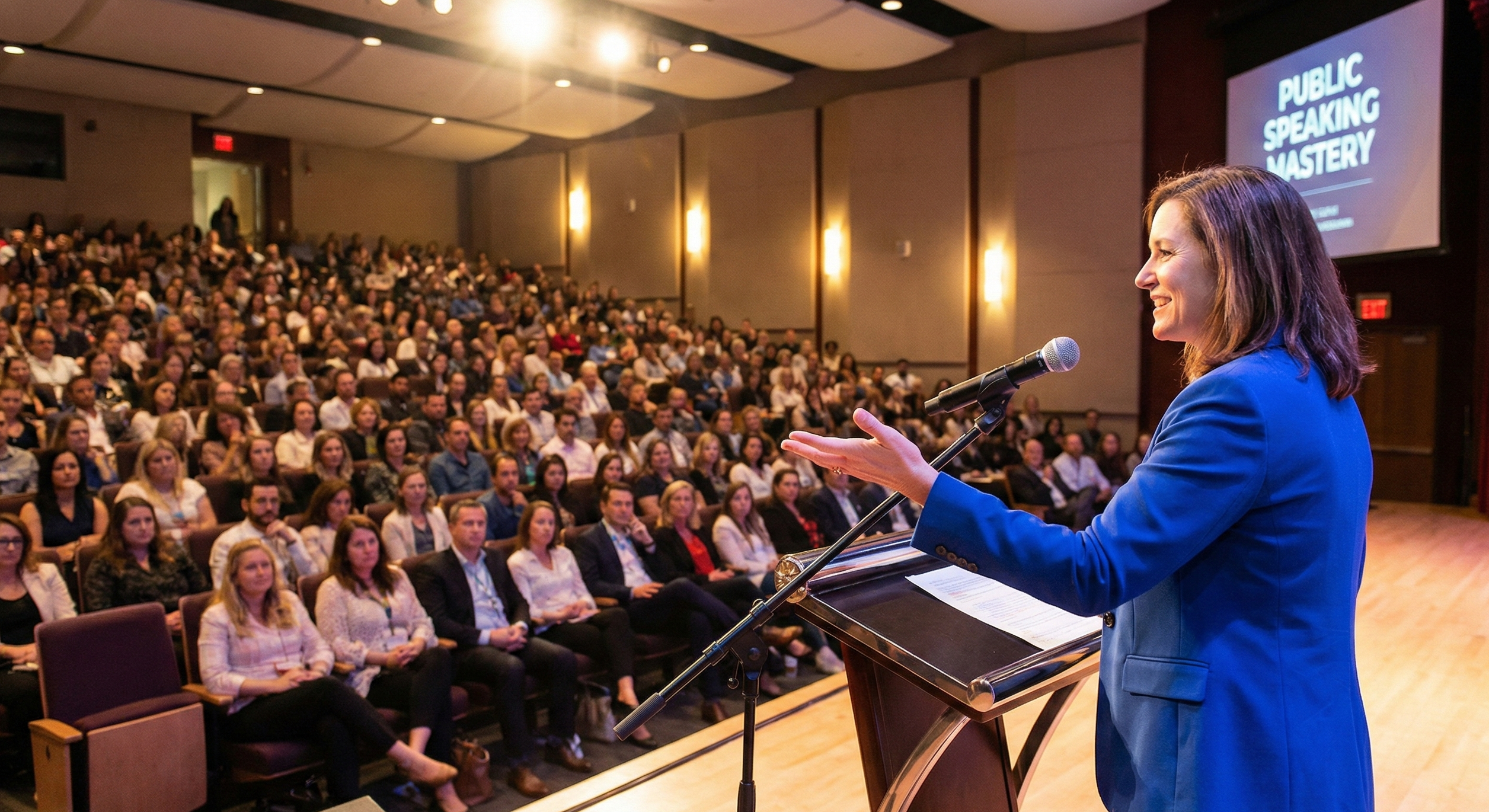
Public speaking courses are often the dividing line between professionals who blend into the background and leaders who command the room. Imagine standing before a crowd, your heart pounding a frantic rhythm against your ribs. The lights are blinding, the silence is deafening, and fifty pairs of eyes are locked onto you, waiting.
For most people, this scenario isn’t just uncomfortable—it is a waking nightmare. In fact, glossophobia (the fear of public speaking) affects roughly 75% of the population. But what if you could change that narrative? What if that silence wasn’t a threat, but an invitation?
Investing in high-quality public speaking courses is not just about learning how to talk; it is about unlearning the fear that keeps you silent. Whether you are a CEO delivering a keynote or a student presenting a thesis, the ability to articulate your ideas with clarity and confidence is the single most valuable soft skill you can possess.
In this comprehensive guide, we will explore everything you need to know about selecting the right training, the psychological breakthroughs you can expect, and the tangible techniques that will take you from a nervous wreck to a polished presenter.
Table of Contents
Why Public Speaking Courses Are a Non-Negotiable Career Asset
In today’s hyper-connected economy, technical skills are merely the entry price. The real differentiator is communication. Public speaking courses provide the competitive edge that accelerates career trajectories.
The Return on Investment (ROI) of Eloquence
Many professionals hesitate to enroll in training because they view it as a “soft skill” with intangible benefits. This is a misconception. The ROI of communication training is concrete and measurable.
According to research by the Carnegie Institute of Technology, 85% of financial success is due to skills in “human engineering,” including personality and ability to communicate, negotiate, and lead. Only 15% is due to technical knowledge.
When you enroll in public speaking courses, you are essentially investing in your ability to sell your competence. You could be the most brilliant engineer or the most innovative marketer, but if you cannot convey your value to stakeholders, your potential remains capped.
Leadership and Persuasion
Leadership is language. You cannot lead a team if you cannot inspire them. Public speaking courses teach you the mechanics of persuasion—how to structure an argument so that it is undeniable, and how to deliver a vision so that it is infectious.
Leaders who take public speaking courses learn to:
- De-escalate conflicts through calm vocal modulation.
- Motivate underperforming teams with compelling storytelling.
- Secure funding and buy-in from skeptical investors.
Networking and Social Confidence
The benefits extend far beyond the boardroom. The confidence gained from public speaking courses bleeds into every social interaction. You become better at small talk, more assertive in negotiations, and more memorable at networking events. When you stop worrying about how you sound, you can finally focus on connecting with the person in front of you.
The Psychology of Fear: What Public Speaking Courses Address
To master the stage, you must first master your mind. The best public speaking courses dig deep into the psychology of stage fright. They don’t just teach you gestures; they teach you how to rewire your brain’s response to stress.
Understanding the “Fight or Flight” Response
When you step onto a stage, your amygdala—the ancient part of your brain responsible for survival—perceives the staring eyes of the audience as a predatory threat. This triggers the “fight or flight” response. Adrenaline floods your system, causing shaking hands, a dry mouth, and a racing heart.
Comprehensive public speaking courses help you understand that these physical symptoms are not a sign of failure; they are simply misplaced energy.
Cognitive Reframing Techniques
Top-tier instructors use Cognitive Behavioral Therapy (CBT) techniques to help students reframe their anxiety. Instead of thinking, “I am terrified,” you learn to think, “I am excited.”
Physiologically, anxiety and excitement are almost identical. By changing the label you put on the feeling, you change your performance. Public speaking courses provide a safe container to practice this reframing repeatedly until it becomes second nature.
The Spotlight Effect
Another psychological barrier addressed is the “Spotlight Effect”—the belief that people are scrutinizing your every flaw. In reality, the audience is usually rooting for you to succeed. Public speaking courses use video feedback to show you the reality of your performance versus your internal perception. Often, the “huge mistake” you felt you made wasn’t even noticed by the audience.
Core Components of Comprehensive Public Speaking Courses
Not all training is created equal. If you are going to invest your time and money, you need to ensure the curriculum covers the three pillars of communication: Visual, Vocal, and Verbal. Here is what you should expect from elite public speaking courses.
1. Visual Communication (Body Language)
Your body speaks before you ever open your mouth. Research suggests that over half of human communication is non-verbal.
- Stance: Courses teach the “neutral stance”—feet shoulder-width apart, weight balanced. This grounds you and projects stability.
- Gestures: You will learn to use “open palm” gestures that build trust, rather than closed fists or pointing fingers which signal aggression.
- Eye Contact: This is often the hardest skill. Public speaking courses teach the “one thought, one person” technique, where you deliver a full sentence to a single individual before moving to the next.
2. Vocal Variety and Modulation
A monotone voice is the death of engagement. Training focuses on the “Four P’s” of vocal delivery:
- Pitch: Varying high and low tones to convey emotion.
- Pace: Speeding up to show excitement, slowing down to emphasize importance.
- Power: Using diaphragm breathing to project volume without straining the vocal cords.
- Pausing: Learning to embrace silence. A well-placed pause can be more powerful than a thousand words.
3. Verbal Structure and Storytelling
You can have great delivery, but if your content is a mess, you will lose the room. Public speaking courses emphasize the architecture of a speech.
- The Hook: Opening with a startling statistic, a quote, or a story.
- The Rule of Three: Structuring information in groups of three, which the human brain finds easier to remember.
- The Call to Action: Ending with a clear directive on what the audience should do next.
Online vs. In-Person Public Speaking Courses
In the digital age, you have more options than ever. Should you click through a video series or stand in a physical classroom? Here is a breakdown to help you decide which format of public speaking courses fits your life.
In-Person Workshops
The Gold Standard. There is no substitute for the adrenaline of a live audience.
- Pros: Immediate feedback from an instructor; the ability to read the energy of a room; networking with classmates.
- Cons: Higher cost; requires travel; fixed schedules.
- Best For: Individuals with severe stage fright who need exposure therapy, or executives preparing for high-stakes presentations.
Online Public Speaking Courses (Live Cohorts)
A middle ground that offers convenience with accountability.
- Pros: Learn from home; often cheaper than in-person; access to global instructors.
- Cons: You miss the physical sensation of a large room; technical glitches can interrupt flow.
- Best For: Busy professionals who need flexibility but still want real-time feedback.
On-Demand Video Courses (Udemy, Coursera, MasterClass)
- Pros: Very affordable; learn at your own pace; access to celebrity instructors (like Chris Anderson from TED).
- Cons: Zero feedback. You can watch a video about swimming, but it doesn’t mean you won’t drown when you jump in the pool.
- Best For: Learning theory and structure, but not for curing anxiety.
| Feature | In-Person | Online Live | On-Demand |
| Feedback | High | Medium | None |
| Cost | $$$ | $$ | $ |
| Convenience | Low | High | High |
| Fear Conquering | Excellent | Good | Poor |
5 Actionable Techniques Taught in Top Public Speaking Courses
You don’t have to wait until you enroll to start improving. Here are five practical techniques straight from the syllabus of advanced public speaking courses that you can apply today.
1. The Power Pose
Popularized by social psychologist Amy Cuddy, this involves standing in a posture of confidence (like a superhero with hands on hips) for two minutes before a speech. This increases testosterone (dominance) and lowers cortisol (stress). While controversial in some scientific circles, many students in public speaking courses report a significant subjective boost in confidence.
2. The 3-Second Rule
Nervous speakers tend to scan the room like a lighthouse, never really looking at anyone. The 3-second rule dictates that you must lock eyes with one audience member for three full seconds before moving to another. This creates intimacy and prevents you from looking shifty.
3. Eliminating Filler Words
“Um,” “Ah,” “Like,” “You know.” These are crutches we use when our brain is searching for the next word. Public speaking courses teach you to replace these fillers with a breath. Silence makes you look thoughtful; “Um” makes you look unprepared.
- Tip: Record yourself speaking for one minute. Count the “ums.” Awareness is the first step to elimination.
4. Anchoring
This is a spatial technique. You assign different parts of your stage to different parts of your timeline.
- Left of Stage: The Past (The problem).
- Center Stage: The Present (The solution/your idea).
- Right of Stage: The Future (The positive outcome).
- Moving physically helps the audience follow the narrative arc visually.
5. Diaphragmatic Breathing
Most people breathe from their chest when anxious, which creates a thin, shaky voice. Public speaking courses teach “belly breathing.” By expanding the stomach on the inhale, you pull air deep into the lungs, providing a column of air that supports a rich, resonant voice.
How to Choose the Right Public Speaking Courses for You
With thousands of options available, selecting the right course can be overwhelming. Do not just pick the first one you see on Google. Use this checklist to ensure you are getting value.
Check the Instructor’s Credentials
Has the instructor actually spoken on big stages? Look for individuals who are active in the speaking circuit, TEDx speakers, or certified coaches from organizations like the International Coaching Federation (ICF). Avoid courses taught by theorists who haven’t faced a crowd themselves.
Look for “Stage Time”
The only way to learn public speaking is by speaking. If a course description says “10 hours of lectures” and “1 hour of practice,” run away. The best public speaking courses should be at least 60% practice and 40% theory.
Assess the Class Size
In a group setting, smaller is better. A class of 50 people means you might only speak once. A class of 10 means you will get on stage multiple times a day. Look for public speaking courses that cap their attendance to ensure personalized attention.
Review the Curricular Focus
- Toastmasters: Best for long-term, slow-and-steady growth and community building.
- Dale Carnegie: Excellent for corporate professionals and interpersonal skills.
- University Programs: Good for academic rigor and rhetorical theory.
- Private Bootcamps: Best for rapid transformation over a weekend.
Success Stories: The Transformative Power of Training
Consider the story of Warren Buffett. The legendary investor famously had a fear of public speaking so severe he would throw up before presentations. He enrolled in a Dale Carnegie course, and today, the certificate from that course is the only diploma hanging in his office. He credits public speaking courses as the most important investment of his life.
Or consider Brené Brown, whose vulnerability on stage has captivated millions. That level of authenticity isn’t accidental; it is a honed skill. By taking public speaking courses, everyday people transform into thought leaders. They learn that their voice matters, and they acquire the tools to ensure others hear it too.
Frequently Asked Questions (FAQ)
Here are answers to common questions regarding public speaking courses.
1. Are online public speaking courses effective?
Yes, they can be highly effective for learning speech writing, structure, and theory. However, for overcoming physical anxiety and mastering body language, public speaking courses that offer live video coaching or in-person workshops are superior.
2. How much do public speaking courses cost?
The price varies wildly. A local Toastmasters membership might cost $100 a year, while executive public speaking courses or private coaching can range from $2,000 to $10,000. Online video courses can be found for as low as $20.
3. Can introverts succeed in public speaking courses?
Absolutely. Introverts often make the best speakers because they tend to prepare thoroughly and listen well. Public speaking courses help introverts manage the energy drain of performance, teaching them how to turn their natural introspection into profound stage presence.
4. How long does it take to see results?
You can learn the basics in a weekend workshop. However, public speaking is a muscle. To become truly proficient, you need consistent practice. Many public speaking courses recommend a 6 to 8-week program to solidify new habits and eradicate old ticks.
5. Do I get a certification?
Most reputable providers offer a certificate of completion. While this looks good on a LinkedIn profile, the real value of public speaking courses is the demonstrated ability to communicate, which you will showcase in every future interview and meeting.
Conclusion: Your Voice is Waiting to be Heard
The fear of public speaking is a heavy burden. It stifles ideas, limits careers, and silences potential. But it is not a life sentence. It is a skill gap, and like any skill gap, it can be bridged with the right training.
Public speaking courses offer more than just technical tips on hand gestures and vocal variety. They offer a pathway to confidence. They provide a safe space to fail, to learn, and to grow until the moment you step onto a stage and realize that you are no longer afraid.
The world is waiting to hear what you have to say. Don’t let fear keep your story untold. Whether you choose a local workshop, an online cohort, or a private coach, take the first step today. Explore the top-rated public speaking courses, enroll, and prepare to find your voice.